Gaming-room access, machine operating hours and online-pokies rules are separate questions, and venue details can change.
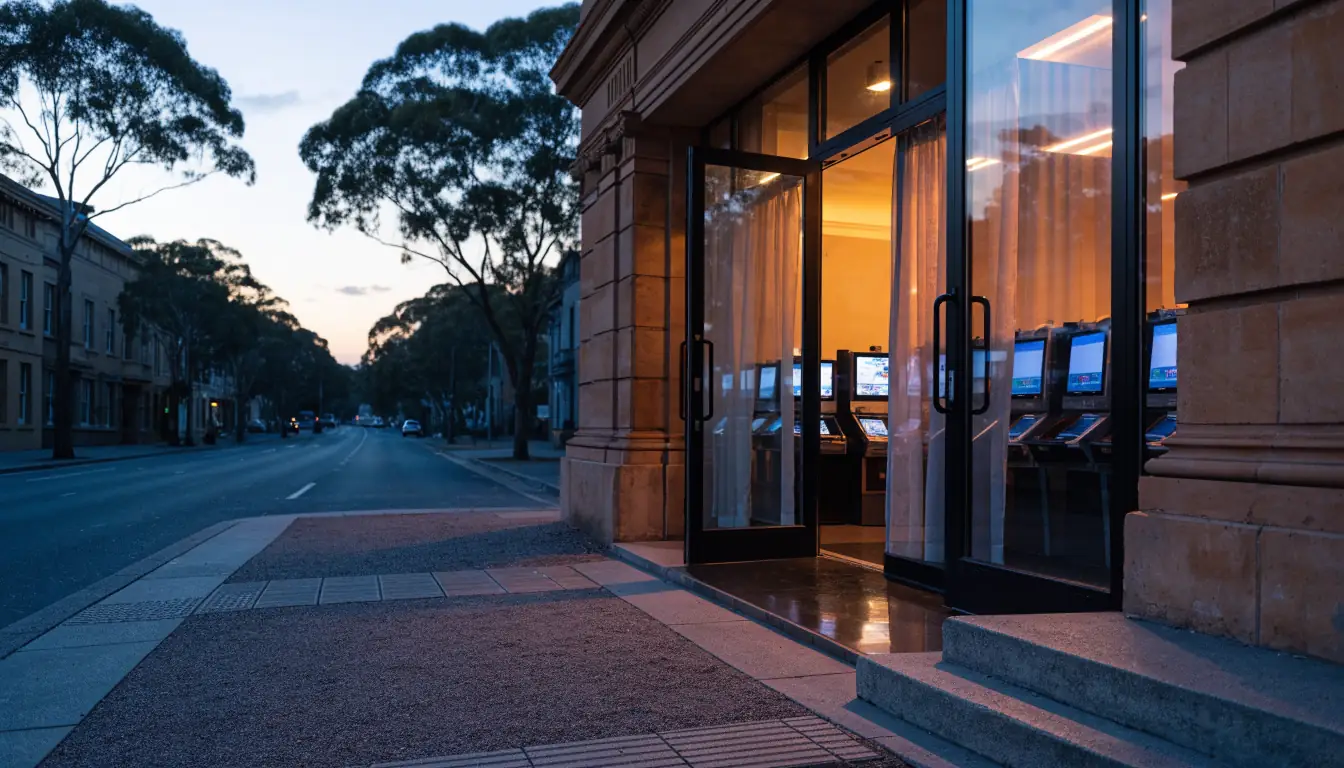
A request for pokies open now sounds like a small logistical question: whether a room is operating at this moment, perhaps early in the morning or late at night. But a city is not a timetable. Adelaide does not have one shared opening time for every gaming room, and “open” can mean different things: a venue may be accessible while its gaming machines are not operating, or its doors may be closed altogether. A late-night search cannot, by itself, settle which applies to a particular place.
That matters for anyone looking for early access, including at six or seven in the morning, or wondering whether a room stays open through the night. A 24-hour label would be a precise claim about a particular venue, not a general feature of Adelaide. Opening hours need to be checked against the venue’s own current information before setting out. The search for a room open now is practical; the answer is necessarily local and time-sensitive.
There is a second clock inside the first: the hours during which gaming machines are operating. A report from regionriverina.com.au describes a requirement taking effect from 1 July: venues with more than twenty machines are to have a dedicated responsible gambling officer, or RGO, on duty during machine operating hours. The requirement is tied to the machines, not simply to the building being open. A dining room or bar being accessible does not, by itself, tell anyone whether gaming is under way or what staffing applies.
The distinction is more than administrative. Opening hours describe access; operating hours define when a particular set of obligations is active. The RGO requirement is specifically connected to the latter. The report also describes a one-month grace period for venues to take down signage and put the officer arrangements in place. That transition period is part of the reported measure, not a permanent alternative to the requirement.
 Best Pokies in Brisbane: Hours and Venue ChecksLearn how venue opening hours differ from gaming-room availability, what local searches can establish, and the stated RGO requirement for venues with…
 NSW pokies: venue hours, access and verified detailsA venue being open does not confirm its gaming floor, a machine or a named game is available. This guide separates those…
The same report says venues will have to maintain a gambling incident register. It is intended to record occurrences, including situations in which a patron’s behaviour suggests they may be at risk of gambling harm or already affected by it. Such a record turns an otherwise fleeting moment into something a venue is expected to notice and document. A person’s distress is not merely a private event when it becomes visible in a public room.
There is an old social bargain in the gaming room: the venue offers recreation, while the state expects the business to recognise when recreation may be turning into harm. The register and the RGO belong to that bargain. They do not establish that every venue has the same number of machines, the same hours, or the same arrangements at every moment. Nor do they tell a person whether a particular room is open tonight. They describe responsibilities attached to the operation of machines.
That is why “open” is an incomplete answer. For a venue search, it refers to access through a door. For a gaming-room search, it also raises the question of whether the machines are operating. The RGO rule described in the report applies while they are. A venue might advertise broad hospitality hours without those hours matching its gaming schedule; conversely, knowing that machines operate at a given time would not establish that the whole venue is accessible in the same way. The terms should not be collapsed.
The regulation also has a threshold: the reported RGO duty applies to venues with more than twenty gaming machines. That makes the requirement specific rather than universal. It should not be casually turned into a claim that every Adelaide room must have the same officer arrangement, or that a venue below the threshold has no other responsibilities. The register requirement is also described as a venue obligation, but the report does not make a directory of local venues or their machine counts. Those are separate questions.
A good answer to “are the pokies open?” therefore has two parts. First, establish whether the relevant venue is open at the time in question. Second, establish whether its gaming machines are operating then. The second part matters because the described staffing duty follows machine operation. Neither answer should be inferred from a city-wide label, an old listing, or the fact that a venue serves customers at other hours. Details can change, and a room’s own published schedule is the appropriate place to verify them.
This is also why a late opening or overnight schedule, where one exists, should not be treated as evidence of a special kind of gaming room. The hours are an access detail; they do not suspend the rules described for operating machines. When gaming is taking place at a venue above the stated threshold, the reported requirement concerns an RGO on duty. The incident register is concerned with occurrences of apparent gambling harm. A clock does not make those concerns disappear.
The language of “open now” can make the issue sound like a simple convenience, as though the only meaningful question were whether the lights are on. Yet a gaming room is a workplace, a commercial setting and a public social space at once. Its operating hours bring people into contact with machines, staff and venue procedures. The oversight described in the report reflects a decision that the venue has responsibilities beyond keeping the doors unlocked.
That is a modest but important shift in emphasis. The practical answer about Adelaide opening times remains venue-specific. The broader point is that machine operation carries conditions of its own, including the reported RGO duty for qualifying venues and the requirement to record incidents related to gambling harm. The two clocks—access and gaming—do not always strike together.
Hours are local. Oversight is not a door sign.
Choosing online pokies for Adelaide means checking the details that matter to you before you play. This list offers a starting point, with each verdict based only on the available information.
WinSpirit Casino
WinSpirit Casino lists a Curaçao eGaming licence, OGL/2024/923/0383, issued through Antillephone N.V. Its minimum deposit is A$30.
Ricky Casino
Ricky Casino lists crypto payouts in under an hour and PayID payouts in 1–3 business days. The minimum deposit is A$20, or A$30 to qualify for the bonus.
Uptown Pokies
Uptown Pokies has operated since 2017 and lists a Curaçao licence. Its minimum deposit is A$20.
Lucky Dreams
Lucky Dreams lists a Curaçao licence and a A$20 minimum deposit via POLi.
JustCasino
JustCasino lists a Curaçao Gaming Control Board licence, providing a licensing detail to consider when reviewing the operator.
SkyCrown
SkyCrown lists a Tobique Gaming Commission licence. Its stated payout times are around 10–15 minutes for crypto and 1–5 days for fiat; the minimum deposit is A$30.
Roby Casino
Roby Casino lists a Curaçao eGaming licence held by Roby Games Ltd.
Golden Pokies
Golden Pokies lists a Curaçao licence, a useful detail to check as part of your review.
Bizzo Casino
Bizzo Casino lists a Curaçao Gaming Control Board licence, with TechSolutions Group N.V. named in connection with it.
Thor Casino
Thor Casino lists a Curaçao licence through Antillephone N.V. (Versus Odds B.V.). Its minimum deposit is EUR 20.
“Best-paying” sounds like a property a pokie might carry, as though one machine had been marked out from the rest. In practice, the phrase can refer to a return-to-player setting, but a game’s name alone does not settle what that setting is. A specialist review reports that some game providers let casinos choose between multiple RTP configurations for the same pokie. The result is that an identical title can be set to different return percentages at different casinos.
That distinction matters when people compare Adelaide pokies by reputation. A familiar title in one venue does not, by itself, establish that the same title elsewhere uses the same return setting. Nor does a game’s popularity reveal its configuration. The setting belongs to the casino’s version of the game, not to the title as a universal promise.
The word “return” can also invite a mistaken reading. An RTP figure describes a setting associated with a game; it is not a forecast for the next spin, or a promise about what a particular player will receive. Treating it as a personal prediction confuses a statistical description with an individual outcome. The machine does not keep a running account of who has won or lost and then adjust the next result to restore an average.
Each spin is generated separately by the game’s random number generator, meaning previous results do not influence the likelihood of a future win or loss.
Each spin is generated separately by the game’s random number generator. A previous win does not make another win due, and a run of losses does not make the next spin more likely to pay. The sequence may look meaningful to someone watching it unfold; the appearance of a pattern is not evidence that the next result has been arranged around it.
That is the awkward gap between “best pokies in Adelaide” and “best-paying pokies in Adelaide”. The first can sound like a judgement about a place or an experience. The second implies a measurable comparison between game settings. Without knowing the setting attached to a particular game at a particular casino, a ranking based on the title alone has little to stand on. An impressive name, a crowded machine or a story about a recent win cannot fill in that detail.
The same caution applies to claims about Adelaide CBD pokies or machines elsewhere in the city. A title can be recognised across venues, while its return setting may not be identical from one casino to another. That does not mean every venue chooses a different setting; it means the name of the game cannot establish that the settings match. A comparison needs more than a shared label.
Randomness complicates the matter further. Even where a setting is known, it cannot tell anyone what a single session will produce. One person may leave ahead; another may lose on the same game. Neither outcome proves that the machine has changed its behaviour for the next person. Random results are particularly good at inviting explanations after the fact. They are less obliging about providing a reliable forecast.
So “best-paying” is not a dependable synonym for “most likely to pay now”. It is, at most, a claim about a configured return that needs to be tied to the specific casino version of a game. A headline that omits that distinction turns a technical setting into a promise. A neat trick.
For anyone weighing a claim about a pokie’s payout, the useful questions are narrow: does the claim identify the setting, and does it apply to that exact game at that exact casino? If it does not, the title alone cannot answer the question. And even a clearly stated setting cannot predict the outcome of the next spin. That remains random.
“Near” sounds precise until a map is asked to define it. For someone arriving at Adelaide Airport, it may mean somewhere reachable before a flight; for someone already in the city, it may mean a short walk from a hotel or office. The same word can describe quite different journeys, and it does not identify a particular venue.
That distinction matters for searches centred on the airport. A phrase linking pokies with Adelaide Airport expresses a location preference, not proof that pokies are inside the terminal or that a particular gaming room sits beside it. The airport can serve as a reference point without being the destination. No distance, route or venue name follows from the wording alone.
A location preference and reference point; does not prove pokies are inside the terminal.
A broad central area reference; may include the central grid or its edges.
A specific neighbourhood label used as a geographical reference point.
The CBD is another reference point, but a broad one. “Near the CBD” might mean within the central grid, at its edge or simply convenient from somewhere in the city centre. North Adelaide adds another neighbourhood label, while “Adelaide, Vic” is less clear still: it could be an imprecise place description rather than a dependable address. Search language compresses geography. It does not resolve it.
A useful distinction is between an area and a verified address. An area helps describe where someone hopes to go; an address identifies a place that can be checked. Without that second step, a result attached to “near me” may not answer whether a venue is actually close to a person’s starting point. Nor does a location label establish which machines are there. A map pin and a claim about local pokies are different kinds of information.
There is a small social history in this habit of asking for what is “near”. Cities are encountered in fragments: the airport, the business district, a northern suburb, a hotel block. Search tools inherit that practical geography and turn it into tidy labels. The labels are useful, but tidiness is not proof. A neighbourhood name can make an answer feel local before it has become specific.
For Adelaide, the careful reading is modest: airport-related wording points to the airport as a landmark; CBD wording points to the central area; North Adelaide wording points to a suburb; and “near me” depends on the person’s location. None of those phrases, on its own, confirms a venue, its exact position or the machines it offers. That is not a defect in geography. It is the difference between a landmark and an address.
 Best pokies in Canberra: hours and local checksA venue’s public timetable may differ from its gaming-room schedule. Learn what local listings can—and cannot—confirm about machine access.
 Big Red Pokies Online in Australia: Free PlayLearn how free play differs from real-money gambling, why a demo cannot predict results, and what the Big Red name alone does…
Age is the one clear boundary that applies regardless of postcode: gambling in Australia is restricted to people aged 18 or older. A location can shape a journey, but it does not alter that rule. A pin can be close. It cannot make the place more certain than the information behind it.
A list of Adelaide venues would look authoritative simply by being a list. It would not, by itself, establish which places have pokies, what their current arrangements are, or whether one is better than another. Venue names and rankings require evidence about the venues themselves; a general account of regulation cannot supply it.
There is a narrower public record worth understanding: the duties reported for venues with larger gaming-machine operations. Region Riverina reported that, from 1 July, a venue with more than 20 gaming machines would need a dedicated Responsible gambling officer (RGO) on duty while those machines were operating. The same report described a requirement for venues to keep a gambling incident register.
The register is intended to capture incidents, including occasions when a patron’s behaviour indicates possible gambling harm. That makes it a record of events requiring attention, not a public scorecard. Its existence cannot show how often incidents occur at a particular Adelaide venue, how staff responded, or whether one venue is safer than another. Those conclusions would need venue-specific information.
Venues with more than 20 gaming machines are required to have a dedicated Responsible gambling officer (RGO) on duty during machine operating hours and must maintain a gambling incident register to record signs of gambling harm.
An RGO requirement also has a defined scope: it applies to venues above the stated machine threshold, and the officer’s duty is tied to the machines operating. It should not be read as evidence that every venue has the same staffing arrangement, or as an endorsement of any venue. Rules describe obligations; they do not award medals.
That distinction matters when trying to identify the best pokies venue in Adelaide. A compliance measure may say something about how a venue is expected to respond to risk, but it does not establish a “best” choice for entertainment, service or machine outcomes. Nor does a general report about a rule confirm how any named Adelaide venue implements it. A ranking would turn a broad obligation into a local verdict without the necessary particulars.
The public record is therefore more useful for asking what oversight is supposed to involve than for choosing among venues. A dedicated officer and incident documentation point to a system designed to recognise and record signs of harm. They do not promise that harm will be prevented, and they do not tell a visitor what conditions are like on the floor.
For searches about Adelaide’s pokies venues, that is a modest but important distinction. Venue oversight belongs in the account; unsupported venue-by-venue claims do not. The record describes duties, not winners.
An Adelaide address does not change the legal status of online pokies. Under the Interactive Gambling Act 2001, companies cannot offer real-money online casino games to people in Australia; no Australian online casino licences have been issued. That leaves no locally licensed casino for real-money online play. The restriction is aimed at operators, not individual players, but that distinction does not make an offshore service locally regulated or give its customers Australian recourse if winnings are withheld.
 Best Pokies in Tasmania: Venue Hours and AccessLearn why a venue’s general trading hours may not confirm machine access, and why current, venue-specific checks matter before visiting.
 Queensland Casinos: Hotels, Gaming and Resort AmenitiesSeparate hotel bookings from casino access and check what room offers actually include. The guide also distinguishes poker, resort amenities and online…
Deposit options do not settle that question. PayID is a way to transfer money through Australia’s New Payments Platform, using an email address, mobile number or ABN as an alias. It is supported by major banks and uses end-to-end encryption; using it for a real-money casino deposit would require linking it to a bank account. None of those features establishes that a gambling service is lawful, fair or transparent about its games.
Nor does a deposit label make the terms simple. A bonus can carry a wagering requirement: the amount that must be bet before associated winnings may be withdrawn. A specialist gambling review has described 35x as a threshold to seek and anything above 40x as punishing. That is the review’s assessment, not a legal standard or a guarantee about what any operator offers.
The arithmetic can be stark. In the review’s illustration, a $500 bonus with a 40x requirement entails $20,000 in bets before the winnings can be withdrawn. If the requirement applies to the deposit as well as the bonus, the same illustration uses $500 plus $500 at 35x, producing $35,000 in required bets. These figures explain the mechanism; they are not a reason to accept an offer. Terms may also restrict which games count, impose expiry conditions or cap cash-outs from free spins. The headline is the least informative part.
Bonus Wagering Calculation
Calculate Bonus Bet
A $500 bonus with a 40x wagering requirement entails $20,000 in required bets before winnings can be withdrawn.
Calculate Deposit plus Bonus
If a $500 deposit and $500 bonus are both subject to a 35x requirement, the total required bets increase to $35,000.
Payment methods carry their own conditions. Credit cards must not be accepted for online gambling services in Australia. PayID’s presence, by contrast, says nothing about a site’s authorisation. A transfer method is plumbing, not a licence.
Identity checks are another practical boundary: before a first withdrawal, gambling services may require identity and address documents to verify an account. That can become a serious exposure when the service sits beyond Australian oversight. BetStop is also limited: it applies to Australian-licensed operators and does not bind offshore sites. Since no Australian-licensed online casino exists, it should not be mistaken for protection from an offshore casino.
The local legal line is therefore clearer than any deposit button or bonus banner. An Adelaide search cannot turn an offshore offer into a domestic service.
A request for online pokies near Adelaide can sound like a local version of a venue search: close by, open on a screen, perhaps with familiar city names attached. But geography does not change the legal position. A website’s willingness to accept someone in Adelaide does not make its real-money casino games lawful for the operator to provide in Australia.
The Interactive Gambling Act 2001 prohibits operators from supplying real-money online casino games, including pokies, to people physically located in Australia. The restriction is directed at the business offering the service, rather than making an individual player liable for using an offshore site. That distinction matters, but it is not a promise of protection. Australians have no legal recourse in Australia if an offshore casino withholds winnings.
Nor does a local-sounding label establish a local venue, Australian oversight or a route for resolving a dispute. “Adelaide” may describe the person’s location, not the operator’s. A page presenting itself as an online extension of Adelaide’s physical gambling scene cannot create a domestic licence where none exists. There is no Australian-licensed online casino.
The Australian Communications and Media Authority (ACMA) enforces the Interactive Gambling Act. It also blocks access to illegal offshore gambling sites, and internet service providers must comply with its blocklist. A site appearing in a search result, or remaining reachable at a particular moment, is not evidence that its service is permitted or protected under Australian law. Access may be interrupted; the legal position does not turn on whether a page loads.
This produces an uneven arrangement. The law places the central prohibition on operators, while the enforcement system can restrict access to offshore services. Meanwhile, a player facing a payment dispute with such a business cannot rely on Australian legal recourse to secure the winnings. Availability and accountability are different things.
Location terms can also blur two distinct subjects. A physical pokie venue in Adelaide belongs to the local venue question; a website offering casino-style games to someone in Adelaide belongs to the federal interactive-gambling framework. Adding “central”, “high limit” or “maximum bet” to the description does not establish that an online service is locally licensed, locally supervised or safer. Those labels describe a pitch, not a legal status.
No Legal Recourse
Because there are no Australian-licensed online casinos, players have no legal recourse in Australia if an offshore casino withholds winnings.
The phrase “best-paying” does not alter that boundary either. It cannot turn an offshore offer into an Adelaide venue or change which law applies. Online access from a particular suburb is still access from Australia. The map is not a licence.
The practical result is less satisfying than a list of nearby options, but more useful: local wording should not be mistaken for local protection. ACMA’s blocking role and the absence of Australian recourse in a dispute are part of the same picture. A familiar city name on a screen may make a service seem close at hand. Legally, it remains an offshore operator’s offer.
Putting Crown and Adelaide in the same phrase does not establish that a Crown venue is in Adelaide. Nor does a venue name, by itself, identify which pokies are available there or what return setting applies to any particular machine. The distinction matters: a familiar casino brand can travel easily through online listings and conversation, while the terms attached to a particular game remain specific to the casino offering it.
A specialist review reports that some game providers let casinos choose among different return-to-player settings for the same pokie. In practical terms, a title’s name alone cannot establish its return percentage at a particular venue. The game may look and play alike while its configured return differs between casinos. A claim about a Crown machine therefore needs evidence tied to that machine and location, rather than a general figure attached to the game elsewhere.
That limitation also applies to the idea of a “best” pokies room. A room cannot be assessed from its brand alone, and a ranking based on the name of a game would leave out the setting that can affect its stated return. No grand conclusion follows from a familiar sign. The details have to belong to the actual venue and machine.
The question of a maximum cash payout is different again. A game’s return setting is not a promise about the amount payable on one play, and it does not establish a venue’s payout arrangements. Those are separate claims, requiring separate, venue-specific terms. A headline number detached from its conditions can sound more definite than it is.
Casino language often compresses several questions into one: whether the venue exists in the stated place, whether a particular pokie is installed there, which return setting it uses, and what payout conditions apply. None can safely stand in for another. A brand association is not a location record; a game title is not a return disclosure; a theoretical return is not a maximum cash payout.
The careful distinction is not pedantry. It is the difference between a name that attracts attention and evidence that describes a real machine in a real room.
A club’s address in Adelaide’s CBD says little about how its gaming room is run. Nor does the word “best” settle anything about a particular venue or its machines. A more useful distinction is between a venue’s individual features, which need checking directly, and safeguards that apply when gaming machines are operating.
A report by regionriverina.com.au describes a requirement taking effect from 1 July: venues with more than 20 gaming machines are to have a dedicated responsible gambling officer (RGO) on duty during operating hours. The officer’s presence connects the room’s activity to a named responsibility, rather than leaving signs and procedures to do all the work. The rule is tied to the machine count, not to whether a venue calls itself a club, hotel or casino.
The same report says venues will need to keep a gambling incident register. It is intended to capture occurrences in which a patron’s behaviour suggests they may be at risk of gambling harm or already affected by it. A register turns an uneasy moment into something that can be recorded and followed up. Paperwork, in this case, has a human subject.
Physical surroundings matter too. Signs pointing towards gaming lounges should not be placed within sight of ATMs or EFTPOS terminals; signs directing patrons to ATMs should not be visible from gaming machines. Such restrictions recognise that a gambling room is not only a set of machines: the route between cash, prompts and play can shape behaviour.
For people seeking self-exclusion from pokies in Adelaide, venue-level arrangements are distinct from BetStop. BetStop applies to Australian-licensed operators and does not bind offshore sites; it is not a substitute for asking a physical venue about its own exclusion process. A CBD club’s specific procedures should be confirmed with that club, rather than inferred from its postcode or from the general rules.
These safeguards do not identify particular clubs, establish how many machines any one of them has, or rank their games. They describe the responsibilities that attach to qualifying venues and the records meant to make signs of harm visible. Not a leaderboard. A duty of care.
“Cashless” can describe a payment rail, but it does not establish that a particular Adelaide venue offers cashless play. Nor does a payment option tell anything reliable about the legality or fairness of a gambling service. PayID is a way to direct a bank transfer, not a seal of approval.
It works through the New Payments Platform (NPP): an email address, mobile number or ABN can act as the alias for a transfer. The NPP is available through all major banks and protects transfers with end-to-end encryption. Those are properties of the payment infrastructure. They do not certify the business receiving money, its games or its handling of winnings.
That distinction matters in Australia, where real-money online casino games cannot lawfully be provided to people in the country. A familiar payment method does not alter that boundary. Cashless payments at a physical venue are a separate question, and the presence of PayID in a search result cannot establish that an Adelaide venue accepts it for pokies.
Newcastle adds another small geographical tangle. It is not another name for Adelaide, and combining the two places does not identify a local venue or prove that a particular machine is available in either city. The phrase may reflect a broad comparison, an imprecise location setting or simply two place names gathered in one search. It is not evidence of a shared local offering.
The more useful distinction is between the city being considered, the venue itself and the means by which a transfer is made. PayID describes only the last of these. Treating it as proof of a venue’s status would be like mistaking a bank transfer slip for a licence. A neat shortcut. A poor guide.
Yes, Australians can legally play on offshore sites that accept them, but companies cannot legally offer real-money online pokies to Australian residents without a domestic licence. No Australian online casino licences have been issued, and players have no legal recourse in Australia if an offshore site refuses to pay.
You must be at least 18 to gamble online in Australia.
The minimum depends on the casino’s deposit terms: most operators accept AU$10–AU$20, while some accept AU$5. PayID is treated like other qualifying deposit methods.
Yes. Some game providers let casinos choose from multiple RTP settings, so the same pokie can have different return percentages at different casinos.