See how real dealers, physical cards, table variations and site conditions shape the experience of online live baccarat.
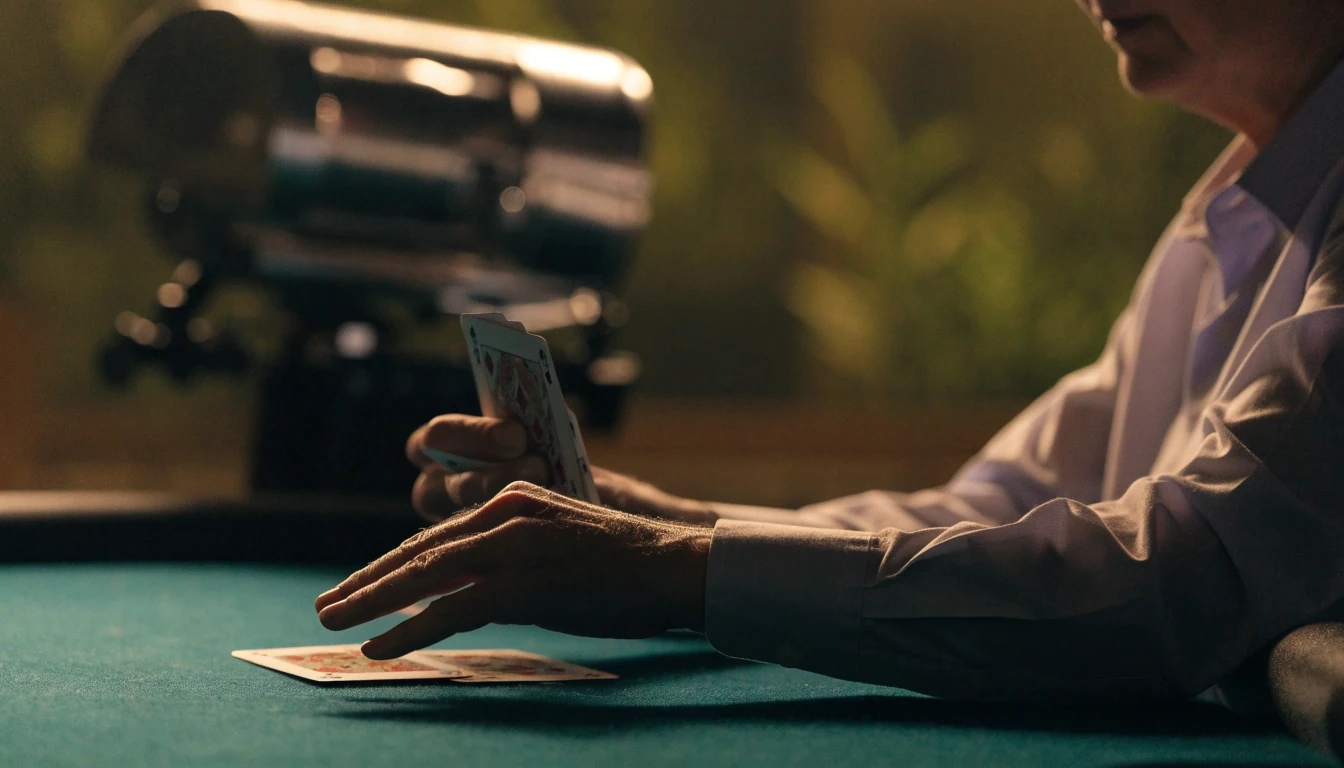
A live baccarat table is not a picture of a casino laid over a computer game. It is a camera view of a real table in a studio: a professional dealer handles physical cards while the game is shown through a stream and represented at a virtual table on screen. The distinction matters. The cards exist before the camera sees them; the software carries the image and the interface, rather than inventing each result.
RNG baccarat works differently. Its outcomes are produced by algorithm-based software, not by cards dealt in front of a camera. Both forms appear on international casino platforms, but they offer different versions of the same ritual. One places a visible human being and a physical deck at the centre; the other leaves the machinery behind the screen. For some players, that difference is the point. A dealer’s measured movements, the pause before a reveal and the shared attention of a table give the streamed version a social texture that a software display cannot quite imitate.
The camera changes the old casino room without abolishing it. The table is elsewhere, the players are scattered, and the dealer’s gestures arrive through a screen. Yet the game still depends on a visible ceremony: cards handled, placed and turned in sequence. It is a peculiar sort of proximity. The dealer is present as an image and a working person, while the players are present as names, avatars or brief messages. Technology has moved the room; it has not removed the performance.
That performance is carefully made. A studio stream frames the table so that the dealing remains legible, while the digital interface lets participants follow the session remotely. The live feed is not simply decoration over an automated game. It is the evidence of a physical process, even though the player does not sit at the table or touch the cards. In this arrangement, the camera is both window and boundary.
Australia gives that distinction a more complicated setting. The Interactive Gambling Act 2001 bars operators from providing real-money online casino games to people located in the country. Baccarat sits within that prohibited category, whether its cards are physical or its results come from software. Australian-licensed operators cannot offer online casino games. The law addresses the service being provided, not whether the table looks convincingly real.
At the same time, Australians do play baccarat through international casino platforms that accept players from the country. That fact describes activity, not legal approval. International availability should not be mistaken for a locally authorised casino market, and a stream crossing a border does not turn the underlying service into something different. The screen can make distance feel ordinary. The legal position is less accommodating.
There is a social history in the format, though not a simple one. Casinos have long made games into public theatre: a dealer’s hand, a table’s pace, the small audience gathered around a result. Live dealer baccarat imports that theatre into private rooms and onto personal screens. The player may be alone, but the game is staged as a shared event. A real dealer supplies the human rhythm; the platform supplies the remote architecture.
That can make live play feel more tangible than RNG baccarat. It can also make the two easier to confuse. Both appear on the same kind of digital platform, and both present a betting interface. But in one, the displayed outcome comes from software; in the other, the stream shows a dealer handling real cards. The difference is not a claim that one is safer, fairer or more desirable. It is a difference in how the game produces and presents its result.
Legal Status
The Interactive Gambling Act 2001 prohibits operators from providing real-money online casino games to people located in Australia.
The word “live” carries a little theatre of its own. It suggests immediacy, a room shared across distance, a human presence at the far end of the feed. Yet the experience remains mediated by a platform and a camera, and its real-money setting carries financial risk. A streamed table may feel more companionable than a sequence of generated outcomes; neither feeling changes the legal restrictions applying in Australia, nor removes the possibility of losing money.
This is not a locally licensed casino scene. It is a prohibited service encountered through international platforms, despite the fact that Australians participate. The distinction should stay visible beneath the stream’s polished surface. A camera can show a dealer and a deck with great clarity. It cannot make the arrangement local, lawful or risk-free.
18+ only. Gambling can cause financial harm. Freshbethubau.com is not liable for losses incurred through gambling.
Choosing a live baccarat casino in Australia means weighing practical details alongside the game itself. Use these operator notes as a starting point, and check the current terms and availability before signing up.
WinSpirit Casino
WinSpirit lists a Curacao eGaming licence, OGL/2024/923/0383, issued by Antillephone N.V. Its stated minimum deposit is A$30.
Ricky Casino
Ricky Casino lists crypto payouts in under an hour and PayID payouts in 1–3 business days. The minimum deposit is A$20, or A$30 to qualify for the bonus.
Uptown Pokies
Uptown Pokies operates under a Curacao licence and has been operating since 2017. Its minimum deposit is A$20.
Lucky Dreams
Lucky Dreams lists a Curacao licence and accepts a minimum deposit of A$20 via POLi.
JustCasino
JustCasino lists a licence from the Curacao Gaming Control Board. That licensing detail is the available point of reference for this listing.
SkyCrown
SkyCrown lists a Tobique Gaming Commission licence. Its stated withdrawal times are around 10–15 minutes for crypto and 1–5 days for fiat, and its minimum deposit is A$30.
Roby Casino
Roby Casino lists a Curacao eGaming licence held by Roby Games Ltd. This licensing information is the available factual detail for the listing.
Golden Pokies
Golden Pokies lists a Curacao licence. No further operator details are provided here.
Bizzo Casino
Bizzo Casino lists a Curacao Gaming Control Board licence, with TechSolutions Group N.V. identified in the licensing details.
Thor Casino
Thor Casino lists a Curacao licence from Antillephone N.V., with Versus Odds B.V. identified in the details. Its stated minimum deposit is EUR 20.
“Best” sounds like a clean verdict: one table, one operator, one answer. In Australia, that language conceals a more basic problem. There are no locally licensed online casinos officially operating in the country, and the Interactive Gambling Act 2001 does not permit Australian-licensed operators to offer online casino games. A comparison of baccarat services aimed at Australians is therefore not a contest between local, licensed alternatives.
That distinction matters. A polished ranking can make an offshore service look like an ordinary domestic choice, when the legal setting is not ordinary at all. A list of winners would imply that the options had been tested against a shared local standard. There is no such standard to apply. The word “best” is more useful as a prompt to ask what a comparison actually measures—and what it leaves out.
The practical measures are less glamorous than a verdict. A table’s minimum stake determines whether a hand fits a modest bankroll; a withdrawal cap affects how quickly a balance can be taken out. Neither establishes that a service is safe, lawful, or suitable for Australian residents. They are details to inspect, not badges of approval.
Published specialist reviews describe live baccarat minimums in the $5–$10-per-hand range, while $1 tables are reported as uncommon. That is a snapshot from review coverage, not a fixed market rule: table terms can differ and change. Still, the distinction is consequential. A nominally low entry point can determine whether a table is accessible at all, while a higher minimum narrows the room for a cautious session. The number on the table is not merely decoration.
 Live Blackjack Online in Australia: Legal ContextLearn how Australia’s Interactive Gambling Act 2001 treats real-money online blackjack and why a live table or polished site does not indicate…
 Real Money Pokies in Australia: Mobile AccessOffshore casinos that accept Australian customers seldom use native apps. Learn how browser play and PWAs work, and what an app icon…
Withdrawal caps call for the same restraint. Specialist reviews report weekly limits of $5,000–$10,000 at offshore sites, but this should be read as reported terms, not a universal schedule or a promise about any particular service. Caps may sit among other conditions governing withdrawals, and a headline figure cannot tell the whole story. For a comparison to be meaningful, it must show the wording and context of the limit rather than treating the largest figure as a prize.
That is where rankings often become thin. A score can compress table access, payment conditions and account rules into a single mark, although those details matter differently to different people. A low minimum may be relevant to one bankroll and irrelevant to another. A high cap may look generous while offering no reassurance about the process behind it. The comparison is only as useful as the criteria it makes visible.
There is also a difference between describing a market and endorsing it. An Australian-facing page can present information about how services advertise their tables without turning that description into a recommendation. In a market without local online casino licences, the absence of a local licence is not a small footnote to a ranking; it changes what the ranking can honestly claim. The careful question is not which name deserves a crown, but whether the stated terms are clear enough to assess.
A sound comparison would therefore resist superlatives and separate measurable details from editorial judgement. It would identify the table stake, state the withdrawal cap as written, and make clear that reported terms are not guarantees. It would also avoid treating an attractive figure as evidence that the underlying service has local regulatory approval. The distinction is plain, if inconvenient.
This approach may not satisfy the appetite for a single winner. It does something more useful: it keeps the financial details in view without disguising the legal setting. Baccarat’s rituals are orderly; the market around an online table is not made orderly by a ranking.
18+ only. Gambling can cause financial harm. Freshbethubau.com is not liable for losses.
A live dealer baccarat game puts a person and a table on screen. The dealer handles physical cards in a studio; a camera carries the deal to a virtual table, where betting takes place in real time. The distinction is not decorative. In RNG baccarat, software determines the outcome; in a live game, the cards are dealt in front of the camera.
That visible ritual changes the feel of the game without changing its basic wager. There is a human presence, a measured pause between actions and a room arranged to make the procedure legible. The dealer’s role is both practical and theatrical: cards are presented, hands are dealt, and the table’s routine continues for viewers joining from different places. A baccarat table becomes a small broadcast set, with the camera doing the work that a physical casino’s architecture once did—making the action visible while keeping each player at a distance.
 Lightning Link Online Pokies in Australia: Venue PlayLearn why the original Lightning Link is a venue-based Aristocrat game in Australia, how its Hold and Spin play works, and what…
 Best Video Slots in Australia: Mobile and RTPSee how mobile slots present the same RNG-based play, how free spins and free play work, and why RTP offers context rather…
Not quite a room.
Some tables also provide a chat function. A specialist review describes players as being able to send messages to the dealer or other participants, though the feature and its availability depend on the table. Such exchanges can make the stream feel less solitary, but they remain a narrow kind of company: messages move alongside a game whose pace and formal sequence are set by the studio. Conversation is optional, and the dealer is at work.
The social element is therefore modest, not a substitute for being in a shared room. A greeting or a brief exchange can acknowledge the other people at the table; silence is equally compatible with the format. The camera offers presence, not intimacy. It shows the dealer and the cards, but does not dissolve the distance between a studio and the people watching from elsewhere.
The financial condition is less atmospheric. A specialist review reports that live-dealer games are often offered only for real money, rather than as free-play versions. In practice, that means a session may require a real-money balance before the table can be joined. The distinction matters because live play is not simply a more lifelike screen placed over the same trial experience. The live stream can be tied to a cash wager from the outset.
Live-dealer games are often offered only for real money, meaning a session may require a real-money balance before the table can be joined.
That requirement makes the bankroll part of the setting. It shapes who can sit at the virtual table and how long they can remain there, even before the cards are dealt. The dealer is visible; the financial exposure is less so. A polished stream can make a wager feel like one more element of the scene, but the money remains real and losses remain possible.
In Australia, this experience exists within a restrictive legal setting. The Interactive Gambling Act 2001 prohibits operators from providing real-money online casino games to people physically located in the country. Describing how a live table works is not an invitation to participate, nor does a foreign platform’s accessibility make the service lawful for operators to provide. The distinction between explaining a format and promoting access matters.
Live dealer baccarat is built around a particular bargain: a human dealer supplies the visible ceremony, while the player supplies attention and, where real-money play is involved, financial risk. Chat may add a faint social layer. It cannot make the wager less consequential.
18+ only. Gambling can cause financial harm. Freshbethubau.com accepts no liability for gambling losses.
Baccarat’s formats differ less in their central idea than in the time allowed for each hand. A standard live table gives the dealer and players room for the familiar pauses: bets close, cards are dealt, the result is displayed, and the next round begins. Speed tables compress that rhythm. The distinction matters because a session is not measured only by how long someone sits at a table, but also by how many decisions—and opportunities to stake money—fit inside that time.
One specialist review puts standard live baccarat at roughly 40–50 hands an hour, compared with more than 80 at Speed tables. Those figures should be read as an account of the tables covered by that review, not as a fixed rate across all providers. Studio procedures, table settings and interruptions can change the pace. Still, the broad contrast is clear: a faster format leaves less time between one hand and the next.
Speed is often presented as a matter of convenience. It is also a change in the texture of play. At a slower table, pauses can make each hand feel distinct; at a faster one, the sequence can become continuous, with less room to reflect before another betting window opens. The cards have not changed. The pressure of the clock has.
A player choosing between formats is therefore choosing a tempo, not a different underlying contest. Standard tables may suit a more measured session, while Speed tables prioritise turnover. Neither pace makes outcomes more predictable. Faster dealing changes how quickly decisions recur, not the basis on which cards are dealt or the result is determined.
The other visible variation is the betting range. Some VIP baccarat tables set substantially higher limits than ordinary tables. A specialist review reports that certain VIP games have allowed wagers as high as A$20,000 per bet. That is a reported upper limit for particular tables, not a general feature or a promise of availability. “VIP” describes a level of access and stakes, not a different form of baccarat.
The contrast can be stark: the same broad table format may be presented at very different financial scales. High limits do not make a game more skilful or less uncertain; they enlarge the amount exposed on each decision. The label is less important than the table’s actual minimum and maximum stakes, which are conditions that vary between operators and games.
Follow a measured rhythm with roughly 40–50 hands per hour, allowing for familiar pauses.
Compress the pace of play to over 80 hands per hour, reducing the time between decisions.
Offer higher financial scales, with some reported upper limits as high as A$20,000 per bet.
In Australia, these formats sit within a difficult legal setting. The Interactive Gambling Act 2001 prohibits operators from providing real-money online casino games to people in the country. Descriptions of standard, Speed and VIP tables are not an endorsement of access or an invitation to play. The regulatory boundary is part of the subject, not a footnote.
A baccarat table can look almost unchanged across formats, while its pace and permitted stakes alter the character of a session. The quietest distinction may be the consequential one: how quickly another decision arrives, and how much money the table permits it to involve.
18+ only. Gambling can cause financial harm. Freshbethubau.com is not liable for gambling losses. If gambling is causing harm, seek support.
The first decision around an online baccarat table is often made before any cards appear: which currency the account displays, and how money is represented in its balance. That question has a particular weight in Australia, where the Interactive Gambling Act 2001 prohibits operators from providing real-money online casino games to people in the country. Payment options appearing on a platform do not alter that legal position.
A specialist review of payment methods for Australian-facing services describes a broad mix: PayID, bank transfers, Visa and Mastercard, e-wallets and cryptocurrency. The list is a description of what may appear in payment menus, not an endorsement or a suggestion that every method is suitable. In particular, credit cards are not an appropriate means of funding online gambling.
Currency can change the arithmetic even before a bet is placed. A balance held in Australian dollars avoids the conversion margin applied when a wallet is denominated in US dollars or euros. The stated margin for those foreign-currency balances is 2.5–4%. On a screen, conversion can look like a small line item; across repeated deposits or withdrawals, it is a cost attached to the currency choice rather than to baccarat itself.
That distinction is useful because the game’s visible action can make money seem abstract. The interface presents a balance, a set of betting areas and a timer; the account is still tracking real value. A currency display does not make a loss less real, and a payment label does not turn a prohibited service into a lawful one. Technology is excellent at making transactions look ordinary.
The table’s basic choices are Banker, Player or Tie, with the hand closest to nine taking the win. That is enough to explain why a first bet might be placed, but it says nothing about the financial conditions surrounding an account. Funding arrangements, currency conversion and the table itself are separate layers, even when a single screen puts them side by side.
Searches for how to play baccarat at a casino often lead quickly to payment instructions, as though opening a balance were simply another rule of the game. It is not. In Australia, the law draws a line at operators supplying real-money online casino games to people physically in the country. A payment method cannot erase that line. Nor does the appearance of familiar banking brands amount to approval of the service.
The social meaning of money is unusually visible here. A hand is settled in moments, while a conversion charge or a balance denomination belongs to the quieter machinery behind the table. The interface may make those mechanics feel incidental. They are not.
18+. Gambling can pose a financial risk. Freshbethubau.com is not liable for any losses.
A live table has a timetable, even when its stream gives the impression of a room open around the clock. Availability can depend on the schedule shown by the operator: a particular table may not run at every hour, and a session can be interrupted when its listed window ends. A specialist review has noted that live baccarat schedules may impose time restrictions. That makes the timetable a practical condition, not decoration beside the table name.
The schedule also matters because live play is organised around a staffed studio rather than a software process running without a dealer. A displayed game may be part of a fixed rotation, with the table opening and closing according to its own operating hours. A site’s lobby can show what is offered, but the schedule’s terms determine when that offer is actually available. The small print has a clock.
Cash-out rules sit at the other end of the session. A balance shown on screen is not necessarily a balance that can be withdrawn at once: offshore operators may set a maximum amount payable over a week. One specialist review reported weekly withdrawal caps in the range of $5,000 to $10,000 at offshore sites. That is a reported range, not a promise about any particular operator; limits can differ, and the written withdrawal terms are what govern an account.
For anyone assessing a site’s terms, the relevant distinction is between the amount held in an account and the amount the operator permits to leave within its stated period. A cap can matter most when a balance is larger than the permitted payout for that week, because the remainder may have to wait for a later payment period. Processing conditions and account checks may also affect the timing, so a headline figure alone is not a complete description of cash-out conditions.
These details are especially important in Australia, where the Interactive Gambling Act 2001 prohibits operators from providing real-money online casino games to people in the country. Offshore offerings do not become locally authorised because they publish schedules or withdrawal rules. This is information about the risks and terms around gambling, not a recommendation to use such services.
18+ only. Gambling can cause financial harm. Freshbethubau.com is not liable for losses incurred through gambling. If gambling is causing harm, seek support from an appropriate Australian service.
The odds at a baccarat table are not evenly distributed across its betting areas. The Banker bet carries a house edge of 1.06%, while the Player bet’s edge is 1.24%. The difference is small, but it gives the Banker wager a statistical advantage over repeated play. A Tie bet is a different proposition: its house edge is 14.36%, substantially higher than either side bet. A tempting payout does not erase that cost.
Commission helps explain the gap. On a standard Banker win, the casino takes a 5% commission from the payout. No Commission Baccarat removes that charge, but the apparent simplification can come with altered payouts for certain Banker totals. The label alone, then, does not settle the comparison; the table’s payout rules matter. Small print, doing its usual work.
A baccarat casino bonus can look more generous than it proves to be. Bonus funds are commonly tied to wagering requirements, and the contribution assigned to each game determines how much qualifying play counts toward meeting them. A specialist review reports live baccarat contribution in the range of 5–15%. That is a reported range, not a universal rule: the operator’s terms set the actual contribution, and a low rate can make a bonus balance slow to clear through baccarat play.
The relevant terms are not only the headline amount. They include whether live baccarat is eligible, how much of each wager counts, and whether different bets or table variants receive different treatment. A bonus can therefore be poorly matched to a player who intends to spend most of a session at live tables. Its value depends on conditions, not typography.
The same arithmetic applies whether a deposit is made through a conventional method or Bitcoin: the payment route does not change baccarat’s house edge. It may affect how funds are handled, but it cannot improve the underlying odds. No bonus changes that either.
For anyone assessing an online baccarat offer, the sensible distinction is between a game’s fixed mathematical edge and an incentive’s conditional value. The first can be compared across bets; the second exists only under its terms. Gambling carries financial risk. Freshbethubau.com is not liable for losses. 18+ only.
A baccarat scoreboard is a record of what has happened at the table, not a forecast of what comes next. Its neat rows and coloured marks can make chance look like a system being patiently revealed. They are better read as a ledger: a compact account of completed hands, useful for following the session but unable to tell the cards what to do.
The cards themselves are reduced to simple values before the hand’s total is displayed. Picture cards count as zero. Once the cards have been added, any total above ten is shown without its left-hand digit. The displayed figure is therefore not necessarily the ordinary sum a person would arrive at by adding the cards in everyday arithmetic.
That small adjustment is central to reading the table. A total may appear lower than the raw sum, not because a card has been overlooked, but because baccarat keeps only the right-hand digit when the sum passes ten. The scoreboard follows that convention, so its numbers describe baccarat totals rather than a running count of every point on the cards.
This can make the display seem almost austere. A court card contributes nothing to the total, and a larger sum is pared back rather than carried forward intact. The cards retain their familiar faces; the arithmetic declines to indulge them. What looks like a full deck is, for scoring purposes, a deliberately narrow vocabulary.
Picture cards count as zero, and for any total above ten, only the right-hand digit is kept (e.g., a raw sum of 15 is displayed as 5).
A casino baccarat scoreboard may place the record beside the live table, allowing the stream and its past results to be watched together. That arrangement gives the session a visible memory. It does not make earlier marks evidence that a particular outcome is due, nor does a sequence of results change how the cards are counted. Pattern is easy to see; prediction is another matter.
For anyone reading a live table, the useful distinction is between the cards in front of the dealer and the simplified result shown on screen. The cards supply the material; the displayed total applies baccarat’s own arithmetic. Once that distinction is clear, the scoreboard becomes easier to follow without asking it to say more than it can.
18+ only. Gambling carries financial risk. Freshbethubau.com is not liable for gambling losses.
A specialist review reports that live baccarat can be accessed on Android and iOS devices. That describes device compatibility, not a promise that every table will load or remain available on every handset. The stream, betting panel and table information all have to share a small screen; a layout that works on a larger display may feel crowded when cards, chips and controls compete for space.
The distinction matters because a live table is not simply a digital game resized for a phone. Its seats are shared among people watching the same dealer and hand. A specialist review notes that trial play may be available, but places are limited by the number of seats at the table. A demo option, where offered, is therefore not necessarily an open-ended way to practise: a seat occupied by another player is unavailable for a trial participant.
That constraint also separates live dealer games from software-led play. An app may show a table on a mobile screen, but access still depends on the table’s availability and the platform providing the stream. Small screen, shared seat.
In Australia, that technical possibility should not be mistaken for local authorisation. The Interactive Gambling Act 2001 prohibits operators from providing real-money online casino games to people in the country, and offshore services are subject to blocking and enforcement. A mobile browser or app does not change that legal position.
18+ only. Gambling can cause financial harm. Freshbethubau.com accepts no liability for losses arising from gambling or from use of third-party services. This information is not an invitation to access or use an online casino.
Baccarat’s central rule is spare: a hand nearer to nine beats one farther away. Bets are placed on Player or Banker, or on a Tie if both hands finish level. “Player” and “Banker” name the two sides of the deal, not the people making the wagers; the terminology has survived because casino language is a museum with a cashier.
The target is nine, not the sum a player might expect from ordinary addition. Card values are reduced to a single digit, so the comparison concerns each hand’s final baccarat total. The dealer follows fixed drawing rules rather than choosing whether another card would be useful. A hand with a total below five receives another card. That condition is part of the procedure, not a decision made at the table.
These few principles explain the shape of a round without turning it into a strategy. The wager identifies which result is being backed; the cards determine which side comes closest to nine. A Tie is a separate outcome, not a third hand competing to beat the other two.
This is a description of the game, not an invitation to play. In Australia, the Interactive Gambling Act 2001 prohibits operators from providing real-money online casino games to people in the country. Baccarat and other forms of gambling can cause financial loss, and Freshbethubau.com is not liable for losses arising from gambling. 18+ only. Gambling should not be treated as a way to make money.
Yes. International casino platforms that accept Australian players offer live baccarat, streamed from a studio with a dealer handling physical cards.
Australians can access live baccarat through international platforms that accept players from the country. However, there are no locally licensed online casinos officially operating in Australia.
Yes. Live baccarat can be played on Android and iOS devices.
It is baccarat played through an online stream of a real dealer handling physical cards at a studio table. Players place bets through a virtual table interface.
Australian-licensed operators cannot offer online casino games, including baccarat, under the Interactive Gambling Act 2001. Australians also play through international platforms, but that availability is not local legal approval.