The brief explains Australia's provider-based legal boundary and flags where evidence does not establish dealer, bonus, odds or site claims.
In Australia, the legal question surrounding online roulette begins with the provider, not with the name attached to a game or the screen on which it appears. The Interactive Gambling Act 2001 prohibits operators from providing real-money online casino games to people physically located in Australia. Roulette falls within that category of casino-style gambling. The restriction applies whether the game is described as an online casino table or presented as a live table with a dealer on screen.
That distinction matters because online presentation can make a service look like a different kind of activity. A streamed table may resemble a visit to a casino; a digital interface may resemble a game on a phone. Neither appearance changes the legal character of a real-money casino service offered to someone in Australia. The law draws its boundary around the service being provided, rather than the design choices used to deliver it.
There is no locally licensed online casino market officially operating in Australia. So a page, app or table that uses casino language should not be mistaken for an Australian-licensed online casino simply because it is available in English, accepts Australian currency, or appears tailored to Australian users. Those features, on their own, do not establish local authorisation. The boundary is less theatrical than a casino floor, but more consequential.
When choosing a live roulette table with English-speaking dealers, check that the casino actually offers the tables and language support you need. The details below provide a concise reference to the operator information available for this list.
WinSpirit Casino
WinSpirit lists a Curaçao eGaming OGL licence, reference OGL/2024/923/0383, issued by Antillephone N.V. Its minimum deposit is A$30.
Ricky Casino
Ricky Casino lists crypto payouts in under an hour and PayID payouts in 1–3 business days. The minimum deposit is A$20, or A$30 to qualify for the bonus.
Uptown Pokies
Uptown Pokies lists a Curaçao licence and says it has operated since 2017. Its minimum deposit is A$20.
Lucky Dreams
Lucky Dreams lists a Curaçao licence and a minimum deposit of A$20 via POLi.
JustCasino
JustCasino lists a Curaçao Gaming Control Board licence. No other operator details are provided here.
SkyCrown
SkyCrown lists a Tobique Gaming Commission licence. Its stated payout times are around 10–15 minutes for crypto and 1–5 days for fiat; the minimum deposit is A$30.
Roby Casino
Roby Casino lists a Curaçao eGaming licence under Roby Games Ltd. No other operator details are provided here.
Golden Pokies
Golden Pokies lists a Curaçao licence. No other operator details are provided here.
Bizzo Casino
Bizzo Casino lists a Curaçao Gaming Control Board licence under TechSolutions Group N.V. No other operator details are provided here.
Thor Casino
Thor Casino lists a Curaçao licence through Antillephone N.V. (Versus Odds B.V.). Its minimum deposit is EUR 20.
The practical distinction between a game’s presentation and its legal status is especially visible in live formats. A camera feed, a dealer’s presence, and a virtual table can create a sense of physical immediacy. Yet a live presentation remains an online service when the game is delivered over the internet. For the purposes of the Australian restriction, that visual resemblance to an in-person venue does not turn an online casino game into an ordinary visit to a local casino.
The same point applies to automated formats. A roulette interface does not become lawful to provide as an online casino game merely because its outcomes are generated by software rather than shown through a live stream. The form of presentation may differ; the relevant boundary does not. The law concerns the provision of real-money online casino games to people in Australia, not whether a camera or a computer performs the visible work.
That is the market-wide rule. It is not an assessment of a particular table, dealer, website, or game version. No claim about a specific service follows from the fact that roulette is familiar as a casino game, nor from the presence of casino imagery on a screen. A service’s wording and appearance cannot substitute for its legal status.
The distinction also guards against a common confusion between access and permission. A website appearing online, or a page describing a casino game, is not evidence that the service is locally authorised. Nor does a foreign-facing presentation create an Australian licence. The existence of an online interface and the legality of providing a real-money casino service to someone in Australia are separate matters.
For people physically in Australia, the legal framework is therefore not a menu of locally licensed online roulette casinos. The Interactive Gambling Act does not permit Australian-licensed operators to offer online casino games, and no locally licensed online casinos officially operate in the country. That is the relevant boundary, regardless of whether a service is labelled “live”, “online”, or simply “casino”.
The law is directed at operators providing prohibited services. That distinction should not be blurred into claims about the status of every person who encounters a casino page, or into a suggestion that an unlicensed service becomes acceptable through a change of device or format. The measured description is enough: real-money online casino games cannot lawfully be provided to people physically located in Australia under this framework.
This is a legal overview, not an invitation to seek out a service beyond the Australian market. It does not establish that any particular site or table is accessible, suitable, or authorised. A polished interface can make a distant service feel local. That is a matter of design, not a change in the law.
18+ only. Gambling can cause financial harm. Freshbethubau.com is not liable for losses arising from gambling.
Legal Prohibition
Under the Interactive Gambling Act 2001, it is prohibited for operators to provide real-money online casino games to people physically located in Australia.
A roulette promotion can be made to sound substantial in very few words. “Bonus” suggests added value; “no deposit” suggests an offer without an initial payment; “live” lends a human face to a digital service. Yet these labels do not explain what is being offered, who could qualify, or what conditions might attach to it. The persuasive work happens before the detail appears.
That distinction matters across searches for roulette bonuses, including offers described as no-deposit promotions. The phrase is a category, not a set of terms. It cannot establish that an offer exists, that it applies to a particular game, or that any resulting funds could be withdrawn. A headline can name a type of promotion without telling the whole story. The small print, if present, is where the practical meaning would have to reside.
There is a similar gap between a game name and a promotional promise. “Lightning Roulette” may appear beside references to live play, but the combination does not itself establish a bonus, a table, or any particular service. “Live” describes a style of presentation in ordinary usage; it does not verify who is dealing, what language the dealer speaks, or whether a promotion is attached. Names can gather atmosphere around them. Atmosphere is not a condition.
The same caution applies when roulette is paired with Bitcoin or other cryptocurrency. A search for a crypto roulette casino may reflect an interest in how a platform handles digital currency, but the phrase alone says nothing reliable about deposits, withdrawals, fees, eligibility, or promotional terms. A payment label is not a guarantee of access or of a particular financial arrangement. Crypto adds its own vocabulary of speed and independence; those associations should not be mistaken for evidence about a specific offer.
Promotional language is especially slippery when it compresses several ideas into one phrase. A roulette bonus might mean a welcome offer, a game-specific incentive, or simply a page discussing promotions. “No deposit” sounds precise, but without the actual conditions it leaves basic questions unanswered: whether the offer is limited to certain users, whether it applies to roulette, and what restrictions govern any winnings. Guessing at those details would turn a familiar phrase into an invented promise.
This is not peculiar to gambling. Advertising often turns complicated arrangements into memorable names. The difference is that money is at stake, and a brief label can carry more emotional weight than information. A promise of something “free” is particularly effective because it shifts attention away from what may be required later. The word remains easy to read. The conditions rarely are.
For the same reason, tips about roulette and promotional claims should not be folded together. A bonus does not explain how a game works, and a promotional label cannot serve as guidance about play. The two subjects may occupy the same page, but their meanings are separate: one concerns an advertised inducement, the other concerns the game itself. Blurring them makes a sales phrase look like useful instruction.
No promotional wording can remove the underlying financial risk of gambling. Participation is restricted to adults aged 18 and over. Gambling can cause financial harm, and Freshbethubau.com is not liable for losses. A polished offer name cannot make those risks disappear.
Roulette is commonly understood as a casino-game category, but the name alone does not describe a particular version, presentation or set of conditions. That distinction matters in online settings, where a familiar game name can appear beside very different interfaces and promises. A label tells little about what is actually offered.
The word carries a cultural history of its own. Casino games turn uncertainty into an organised public ritual: there is a recognised name, a place for a wager and an outcome that gives the event its meaning. The ritual can be dressed in polished graphics or presented as a live performance, but appearance is not evidence of identical play. The distinction between a game’s identity and its presentation is easy to overlook, especially when a screen compresses both into one tile.
No particular version can be described as the standard one, and no account of its mechanics follows merely from the name. Nor does a familiar casino label establish how a digital version works, whether a live dealer is involved, or what conditions apply. Those are separate claims, not details safely supplied by association.
This restraint is not a refusal to describe casino games. It is a way of keeping description separate from invention. Those details belong to baccarat. They cannot be carried across to roulette because both games occupy the same broad casino category. Similar packaging is not proof of similar construction.
That boundary also helps make sense of phrases such as “roulette game” and “roulette casino game.” In ordinary English, both point to the same general subject; neither, by itself, identifies a precise product. A casino app is likewise a delivery format, not a guarantee about what a named game contains. The interface may make a category look settled before the underlying details have been established. It is a neat trick of presentation.
The same caution applies to labels that sound more specific. A name associated with a particular roulette tradition cannot be treated as evidence that a particular version is available or that its rules are known. Specificity in a label is not specificity in the evidence. A claim about one version needs support about that version, rather than an assumption drawn from the broader game name.
In Australia, the language surrounding casino games also sits within a regulated setting. That context does not turn a label into proof of an authorised product, nor does the appearance of a game name settle what service is being described. The boundary between a category and an actual offer remains important; the name alone cannot bridge it.
So roulette can be identified at the broadest level as a casino-game subject, while claims about its particular forms and presentation require care. This leaves a narrower, more honest description than a catalogue would offer, but it avoids dressing guesswork as expertise. A name is not a specification.
A beginner’s guide is supposed to make an unfamiliar activity legible. It should show how a session begins, what choices are available and what happens after a choice is made. Without reliable roulette instructions, however, a step-by-step account would be theatre: confident verbs arranged around details that have not been established.
That distinction matters. A description of roulette as a casino game is not the same as an explanation of how to take part. Nor does familiarity with other table games supply the missing steps. Each game has its own procedures; borrowing another game’s conventions would give a novice a false sense of understanding.
The same restraint applies to the wish to win. No honest beginner’s guide can turn a game into a dependable source of income or promise that a particular approach will produce a favourable result. A claim of certainty would be a sales pitch, not instruction. The attraction of a simple method is understandable: games of chance invite people to look for patterns and a sense of control. But a compelling story about a system is not proof that it can secure an outcome.
This leaves the practical question of what a useful introduction can responsibly do. It can insist that the game’s actual instructions be clear before anyone participates, and that uncertainty should not be disguised as expertise. It cannot fill gaps with plausible-sounding steps or present unverified guidance as a working method. A beginner deserves less performance and more accuracy.
There is also a difference between understanding a game and being able to access it. In Australia, the Interactive Gambling Act 2001 prohibits operators from providing real-money online casino games to people located in the country. A how-to explanation should not be mistaken for an invitation to seek out a service that the law does not permit operators to provide. Nor does an online payment label, including PayID, establish that a roulette service is lawful or available.
The human appeal of a beginner’s guide is easy to understand. Rules make a social ritual feel manageable; a table, a sequence of choices and the hope of a result can turn uncertainty into something that appears orderly. Yet clarity has to come before participation, not be improvised afterwards. Where the steps cannot be stated accurately, silence is more useful than a fabricated tutorial.
This page is not a roulette instruction manual. It does not provide a method for placing bets or a route to winning. That is a limit worth keeping visible, rather than hiding beneath the brisk tone of a lesson.
18+ only. Gambling involves financial risk and can cause harm. Freshbethubau.com is not liable for gambling losses.
A rules page should tell a coherent story about what happens at the table: what choices are available, when betting closes, how outcomes are settled and what each result means. Those details belong to a particular game. A description of baccarat cannot serve as a substitute simply because both games appear under the broad heading of casino play.
Baccarat offers a useful illustration of the problem. Its bets concern the Player, the Banker or a tie, and the hand nearest nine wins. Picture cards count as zero; when a total exceeds ten, the left-hand digit is discarded. A further card may be dealt when the total is below five. These are rules built around cards and hand totals. They explain baccarat, not roulette.
Baccarat Basics
Baccarat bets involve the Player, the Banker or a tie, where picture cards count as zero and the hand nearest nine wins.
Moving those details into a roulette explanation would be more than an untidy comparison. It would give the wrong account of how a different game works. The distinction matters especially in live casino settings, where the visible dealer and the streamed table can make a general description sound more authoritative than it is. A camera shows a scene; it does not establish the rules governing every table shown.
The phrase “casino roulette rules” can cover several separate questions. It may refer to the choices available during a round, the point at which bets are accepted or closed, the way a result is determined, or the payment attached to a winning selection. A concise account would need to specify which version of the game it describes and avoid treating one table’s terms as universal. None of those details can be supplied by borrowing baccarat’s card values or drawing conditions.
That boundary is not pedantry. Rules are the small machinery beneath a game’s public face. They determine what a player is choosing and how the table interprets that choice. When the machinery is unknown, a confident explanation does not become useful merely by sounding familiar. It becomes fiction with the manners of instruction.
The same caution applies to live roulette. A live dealer format identifies a human dealer and a streamed setting; it does not, by itself, establish a particular table’s betting procedure or settlement terms. A general label is not a rules document. For any game, the applicable terms would need to be stated by the operator offering that table, and any account of them would need to match that specific game rather than a neighbouring one.
Australia’s legal setting also makes neutral wording important: a discussion of casino roulette should not be mistaken for an offer to play. The Interactive Gambling Act 2001 prohibits operators from providing real-money online casino games to people in Australia. Describing rules in the abstract does not change that boundary, nor does a live stream make a prohibited service lawful.
A responsible account therefore stops where the game-specific detail stops. It does not turn baccarat’s card logic into roulette procedure, and it does not imply that a live table is available simply because the format has a familiar name. The distinction is plain. Essential, too.
18+ only. Gambling can cause financial loss. Freshbethubau.com is not liable for gambling losses.
“Best” sounds like a verdict, but it often conceals several different judgements. A casino might be praised for its interface, its range of tables, its payment arrangements or its advertised odds. Those are not interchangeable qualities. A claim about the best live roulette casino, in particular, would need to say what is being compared and by what measure. Without that, the superlative does more work than the evidence.
Odds are narrower than reputation. To compare the odds of roulette bets, a calculation needs the probability of each relevant outcome and the payout attached to it. The rules governing the game matter too: change those, and the calculation may change. A payout displayed without its conditions is not enough to establish the value of a bet; a probability stated without the matching payout is no better. Arithmetic needs both sides of the bargain.
That is the distinction between a game’s odds and a casino’s quality. An operator’s presentation or service cannot, by itself, make a bet mathematically more favourable. Nor does a polished table, a confident dealer or a striking claim about value settle the question. Such features may shape the experience, but they are not substitutes for the terms on which outcomes are paid.
A responsible comparison would therefore need comparable information for each game: the applicable rules, the available bets, the associated payouts and a transparent method for calculating the results. It would also need to keep unlike products apart. Comparing two tables only makes sense if the relevant conditions are alike, or if the differences are clearly accounted for. Otherwise, a ranking can appear precise while quietly comparing different things.
This is where “best odds” becomes a demanding phrase. It should refer to a defined mathematical comparison, not a general impression or a promotional label. A list of the best roulette casinos would require more still: a stated standard for operator quality, evidence that each entry meets it, and a clear explanation of how the ranking was reached. A casino may be judged highly for one feature and poorly for another. A single crown hides the weighting.
There is a social habit behind such rankings. Lists make complicated choices look settled; they turn scattered details into a tidy order. The form is comforting. The method matters more.
For roulette, that method cannot be replaced by figures from another table game. Baccarat calculations, for instance, do not establish roulette probabilities or payouts. Familiarity with casino mathematics is not a licence to transfer one game’s numbers to another. Each game’s own rules and payment structure must carry the calculation.
The phrase “best roulette strategy casino” also blends two separate questions: whether a strategy has a mathematical basis, and whether an operator offers favourable conditions. Neither answer follows from the other. A strategy cannot be assessed by a casino’s reputation, and a casino cannot be ranked by attaching a strategy label to it.
A useful standard is modest but firm: numerical claims should identify what is measured, under which rules, and how the comparison was made. Without those particulars, “best” is decoration. Odds are arithmetic. Reputation is not.
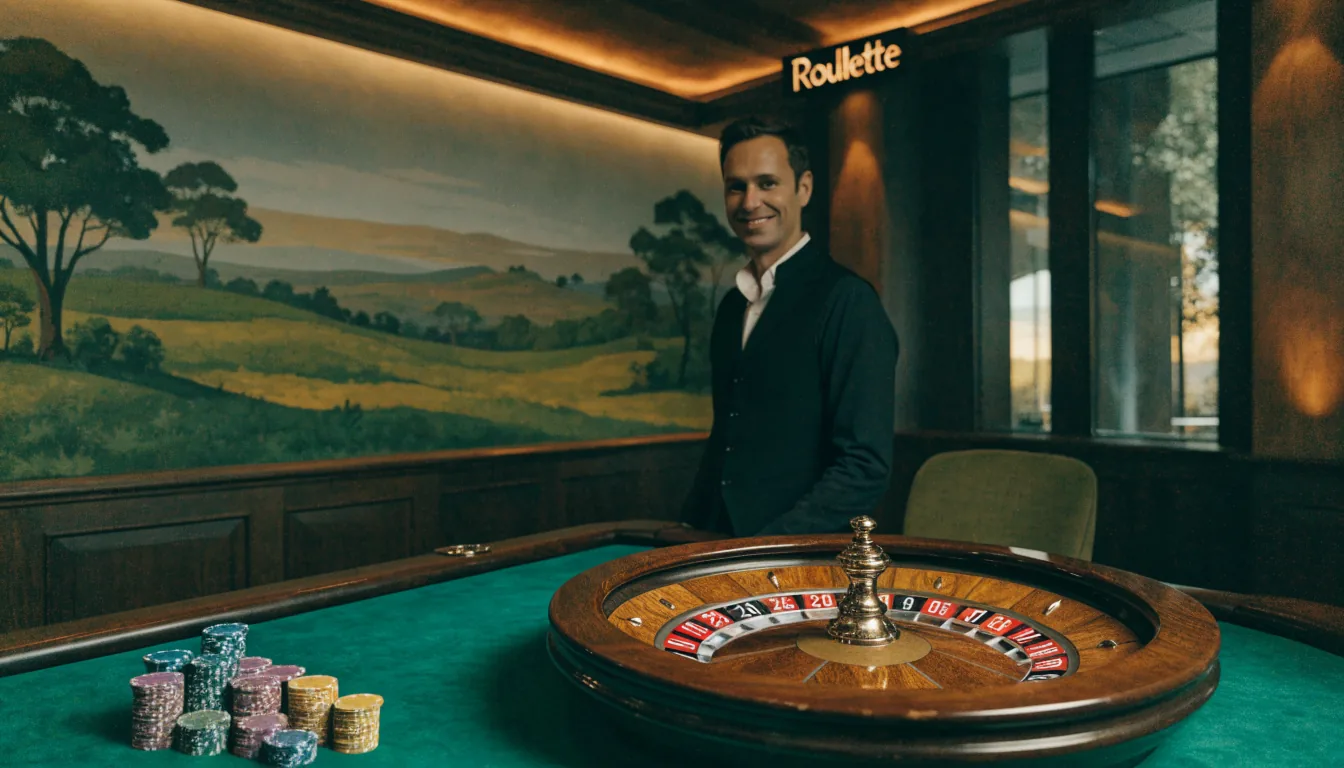
A roulette wheel carries more than a visual promise. It suggests a physical object turning before a result is known, and, in a live setting, a person whose gestures and speech make the event legible. That image is familiar enough to shape expectations of an online casino. It is not, by itself, evidence that a roulette wheel is being streamed or that a dealer is present.
The distinction matters in Australia, where the interest in live roulette with English-speaking dealers combines two separate expectations: a roulette game presented live, and a dealer able to communicate in English. Neither follows simply from the words used to describe a service. A still image of a wheel, an animated interface, and a live video table would convey different things, even if all appeared under a roulette label.
The dealer’s language is not a decorative detail. In live dealer games, speech can help make a streamed event feel social rather than mechanical; it can also clarify what is happening at the table. Yet a general description of live dealer games cannot establish that a particular roulette table exists, that its dealer speaks English, or that its stream is available to people in Australia. Those details require specific, current confirmation—and should not be inferred from a broad category name.
There is a small cultural history in the expectation. The wheel belongs to the public theatre of the casino: a visible object, a gathered audience, a voice announcing events. Online interfaces inherit that theatre while sometimes replacing its physical signs with software and graphics. The resemblance can be persuasive. It is still resemblance.
For the same reason, “casino roulette wheel” and “online roulette” are not interchangeable descriptions. The first evokes an object; the second can refer to a digital presentation without establishing how it works. Neither phrase confirms a live dealer, the dealer’s language, or the equipment shown. A careful description would need to say what is actually presented, rather than letting the familiar picture answer on its own.
For Australian readers, the phrase “English-speaking dealer” should therefore be treated as a specific service claim, not a natural feature of every live table. The presence of a wheel image cannot verify it. Nor can the word “live” settle whether the table is roulette or whether communication is in English.
Details matter. A label is not a demonstration.
18+ only. Gambling can pose a financial risk. Freshbethubau.com is not liable for losses.
“Real-money roulette” describes a wager made with money rather than a no-stakes demonstration. In Australia, however, that phrase cannot be treated as a promise of a lawful online service. The Interactive Gambling Act 2001 prohibits operators from providing real-money online casino games, including roulette, to people physically in the country. That boundary matters more than the wording on a page or the currency shown beside a betting control.
European roulette is a separate description of a game format, not evidence that a table is available to Australians. No reliable conclusion about its rules, wheel, payouts, or conditions follows from the label alone. A title can travel more easily than the service it appears to describe.
The distinction between a named game and an authorised offer is an old commercial trick in newer clothes: presentation suggests access, while legal status belongs to the underlying service. Here, the law is directed at operators. It does not turn a search for roulette into proof that a real-money game is available, nor does it establish what a particular site might claim to provide. This is not an invitation to find another route.
Claims about winning real money online are especially thin ground. A displayed game name, a promotional phrase, or a balance denomination cannot establish that winnings can be withdrawn, that play is lawful for an operator, or that a particular roulette format is being offered. No dependable conclusion about those matters can be drawn merely from the words “European roulette” or “real money.”
Gambling can cause financial loss. Freshbethubau.com is not liable for losses incurred through gambling. This page is for adults aged 18 and over; gambling should not be treated as a way to make money. If gambling is causing harm, seeking support is more important than continuing play.
Attention: A game's name or the currency shown beside a betting control does not establish that a real-money service is lawful or available in Australia.
The vocabulary may promise a table. It cannot change the law.
A roulette strategy is often sold as a way to make chance behave: follow a sequence, change the size of a stake, or wait for a pattern to appear. The appeal is understandable. A sequence gives uncertainty a shape, and a rule can feel like control. But a betting routine is not a promise of profit. No system can turn a win into a certainty.
That distinction matters when strategy advice is presented alongside casino-site recommendations. A confident tone, a neat chart or a claim of “smart” play may make an approach sound tested and dependable. Presentation is not proof. Nor does a site’s polished design establish that a strategy works or that its claims deserve trust.
The language of systems can also shift attention away from the basic financial risk: money staked can be lost. A plan may organise decisions, but it cannot remove that possibility. The more a strategy is framed as a route to guaranteed winnings, the more caution its promise warrants. Certainty is the least credible feature of a game built around uncertain outcomes.
Site comparisons carry their own weight. A ranking or endorsement can look like neutral guidance while encouraging participation, so it should not be mistaken for evidence that a platform is suitable or that play is safe. In Australia, real-money online casino services are prohibited for operators to provide to people in the country; a promotional list would not change that boundary. The commercial invitation and the legal position are not the same thing.
There is no responsible way to turn unsupported assurances into a winning method, or to present casino sites as a route around risk. The sober account is less theatrical: strategies may shape how someone chooses to stake, but they cannot guarantee the result. A site cannot guarantee it either.
18+ only. Gambling can cause financial harm. Freshbethubau.com is not liable for gambling losses. If gambling is affecting someone’s wellbeing, support is available through appropriate local services.
A roulette table is more than a surface for placing wagers. Its numbered field turns chance into a visible arrangement: each position has a place, and every bet must be understood through that layout. The felt is a small civic map, orderly enough to make uncertainty look administrable.
That visual order should not be mistaken for a measure of advantage. A table layout shows where bets are placed; it does not, by itself, establish the chance attached to each one or the share retained by the house. Those figures depend on the game’s rules and configuration. Without those particulars, a numerical comparison would be decoration dressed as analysis.
The distinction matters because “house advantage” is often used as though it were a fixed label attached to roulette as a whole. It is not a useful figure unless its basis is clear: which version is being discussed, which bets are included, and what assumptions support the calculation. A number detached from those details can sound precise while saying very little.
The same caution applies to diagrams. A familiar arrangement on a screen may help explain where selections appear, but an image alone cannot establish the terms of a particular table. Nor does a polished interface settle what a displayed advantage means. Presentation is not evidence.
There is a broader habit at work here. Gambling systems translate uncertainty into rows, colours and categories, making a contingent outcome resemble a well-filed account. The layout offers legibility; the mathematics must do the harder work. A tidy table is no guarantee of a tidy explanation.
For anyone comparing roulette tables, the useful questions concern the exact rules behind the display and the method used to calculate any stated edge. If those are not made clear, a confident-looking percentage should not carry much weight. Precision has to be earned.
Yes, international platforms offer live dealer baccarat to Australians, and Australians regularly play through them. However, Australian-licensed operators cannot offer online casino games, and no locally licensed online casinos officially operate in Australia.
Australian-licensed operators cannot provide online casino games, including baccarat, to people in Australia under the Interactive Gambling Act 2001. There are no locally licensed online casinos officially operating in the country.
A real dealer deals physical cards at a studio table, and a video stream lets players follow the game and place bets in real time. Players bet on the Banker, Player or Tie; the hand closest to nine wins.
The Banker bet is generally the better choice: its house edge is 1.06%, compared with 1.24% for the Player bet and 14.36% for Tie. No Commission Baccarat may change payouts for certain Banker totals.
Sometimes, but trial play is limited because live tables have a limited number of seats. Live dealer games are often offered only for real money.
Some live baccarat schedules have time restrictions. Check the schedule for the table you choose.