Separate the practical details of an in-person casino visit from the legal limits on online gambling in Australia.
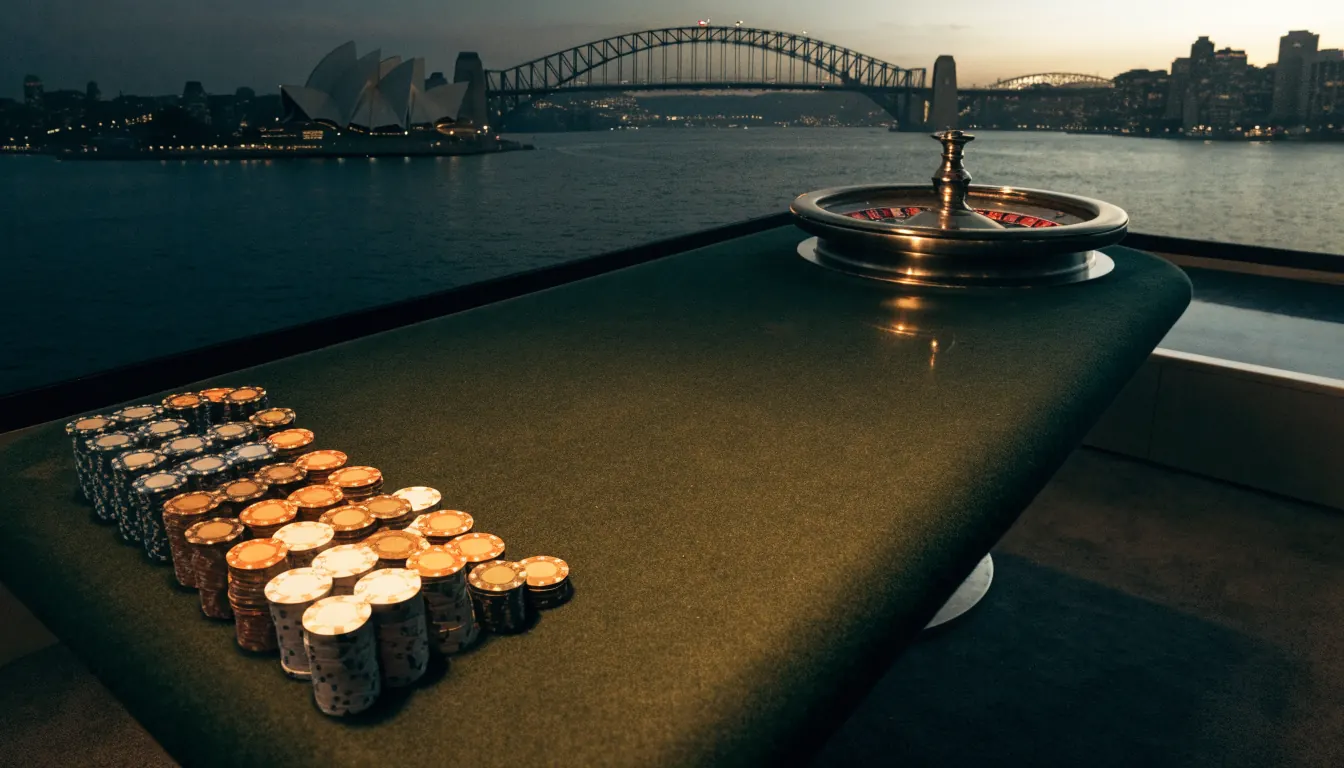
The phrase “casino in Sydney” can describe a physical venue, while “online casino” refers to gambling services delivered over the internet. The distinction matters in Australia: the rules governing a local casino do not make online casino games lawful when offered to people in the country.
The Interactive Gambling Act 2001 prohibits operators from providing real-money online casino services to customers physically located in Australia. That covers games such as pokies, blackjack and roulette. An Australian-run online casino cannot lawfully offer those services to people here. A search for an online version of a Sydney casino therefore does not point to a digital extension of the venue; it points to a different kind of service, subject to a different legal regime.
This boundary can be obscured by familiar words. “Sydney casino bingo” or “casino dining Sydney” may refer to activities or amenities associated with a physical visit. Adding “online” changes the question. It is no longer about a city venue, but about internet gambling, where the law places restrictions on operators serving Australians. Similar wording does not mean similar legal status.
Choosing an online casino while in Sydney means weighing practical details alongside the operator’s stated credentials. These brief verdicts highlight the specific information available for each option.
WinSpirit Casino
WinSpirit lists a Curaçao eGaming licence, OGL/2024/923/0383, issued through Antillephone N.V. Its stated minimum deposit is A$30.
Ricky Casino
Ricky Casino lists crypto payouts in under an hour and PayID payouts in 1–3 business days. The minimum deposit is A$20, or A$30 to qualify for the bonus.
Uptown Pokies
Uptown Pokies operates under a Curaçao licence and has been operating since 2017. Its stated minimum deposit is A$20.
Lucky Dreams
Lucky Dreams lists a Curaçao licence and a A$20 minimum deposit for POLi.
JustCasino
JustCasino lists a licence from the Curaçao Gaming Control Board. That licensing detail is the available basis for assessing it here.
SkyCrown
SkyCrown lists a Tobique Gaming Commission licence and a A$30 minimum deposit. Its stated payout times are around 10–15 minutes for crypto and 1–5 days for fiat.
Roby Casino
Roby Casino lists a Curaçao eGaming licence held by Roby Games Ltd. The available information for this verdict is limited to that licensing detail.
Golden Pokies
Golden Pokies lists a Curaçao licence. No other operator details are provided here.
Bizzo Casino
Bizzo Casino lists a Curaçao Gaming Control Board licence, with TechSolutions Group N.V. named in the licensing information.
Thor Casino
Thor Casino lists a Curaçao licence through Antillephone N.V., with Versus Odds B.V. named in the details. Its stated minimum deposit is EUR 20.
Offshore platforms occupy a more complicated position. It is technically not illegal for an Australian player to use one, but such a platform is not regulated under Australian law. That distinction is easy to flatten into a reassuring slogan; it should not be. The law’s prohibition applies to operators providing the service to Australians, while an offshore operator’s presence does not give the platform local oversight or the protections that come with it. Services may also be blocked or otherwise inaccessible from Australia.
In practical terms, the phrase “online casino Sydney” can describe a search for an offshore site, but it should not be read as evidence that the site is approved to operate locally. Nor does the fact that a platform can be reached establish that Australian rules govern its conduct. The legal grey area concerns the player’s position in using an offshore service; it does not turn that service into an Australian-licensed casino.
There is a broader policy contrast here. Australian law permits sports betting to remain widely accessible, while treating online casino-style games as prohibited services when offered to people in the country. The distinction is not a verdict on whether one form of gambling is harmless. It is a line drawn by legislation, and it determines what operators may provide.
For someone comparing the “best casino in Sydney” with an online option, the first question is therefore what kind of place or service is being considered. A physical casino belongs to the city’s regulated venue landscape. An offshore website is not its online counterpart in any legal sense. Names may overlap. Jurisdiction does not.
 Casino in Tasmania: What the Search Can ConfirmThis overview separates what a search for a Tasmanian casino stay can establish from unverified details on rooms, facilities, dining, events and…
 Pokies in Adelaide: hours, venues and legal limitsLearn why Adelaide has no shared gaming-room opening time, how venue claims are assessed, and where Australian online-pokies rules apply.
A casino hotel promises a particular kind of convenience: a room and a gaming venue under the same broad travel plan. That promise is easy to overread. The label does not, by itself, establish what a room contains, what a stay costs, or which facilities are included. Those details belong to the specific property and booking conditions, not to the phrase “casino hotel”.
For anyone comparing a Sydney casino hotel with an ordinary city stay, the useful distinction is practical rather than glamorous. The hotel component is accommodation; the casino is a separate venue with its own rules and operating arrangements. Being a guest should not be taken to mean that every part of the property is available at every hour, or that access to the gaming floor is included in a room booking. Hotel terms and venue conditions may differ.
The phrase “casino hotel deals” can cover very different things. A displayed rate may depend on dates, room category, cancellation terms or what the booking includes. A lower headline price is not necessarily the more useful one if the conditions are less flexible or additional charges apply. Before confirming a stay, the booking details deserve more attention than the promotional wording: what is being reserved, when payment is due, how changes are handled and what the total price includes.
That is less thrilling than a glossy photograph. It is also more useful.
Room descriptions should be read literally. A photograph cannot establish the view, layout or precise contents of the room assigned; nor does a general hotel description confirm that every room has the same features. The booking record is the relevant reference for the selected category and its terms. If a particular feature matters to the stay, it should be confirmed with the hotel rather than inferred from the casino setting or from images used to market the property.
Opening hours require the same separation of categories. A hotel stay does not establish the casino’s hours, and a venue’s schedule does not describe hotel check-in or other accommodation arrangements. These are distinct pieces of information that can change independently. A visit planned around a particular time should therefore be based on the relevant property’s current information, not on an assumption that the hotel and casino operate as one continuous service.
There is a broader point in the appeal of the casino hotel. It packages leisure as proximity: sleeping near the place associated with the evening’s entertainment can make the trip feel self-contained. Yet proximity is not a guarantee of value, and it does not turn gambling into a hotel amenity in the ordinary sense. Under Australian law, real-money online casino games are prohibited when offered by operators to people in Australia; an in-person hotel stay is a different matter from using an online casino service. The distinction is worth keeping clear, especially when booking pages and gaming language sit close together.
A room is still a room, not a financial plan. Gambling outcomes are uncertain, and there is no reliable route from a hotel booking to a profitable night. The sensible measure of a stay is whether its terms suit the trip, not whether the casino might somehow pay for it. No room rate can make that wager less uncertain.
For a Sydney casino hotel, the most grounded comparison is therefore between the accommodation terms actually offered: the selected room, the total price, the cancellation conditions and the dates. Casino access and venue hours should be checked separately. This leaves less room for the word “deal” to do the work of detail—and less reason to mistake a building’s shared address for a shared set of promises.
Poker in a casino and poker machines share a name but not a format. A poker room is associated with people playing against one another; a pokie is an Electronic Gaming Machine (EGM), whose outcome is determined by the machine. Searches for a Sydney poker room or tournament often place these activities side by side, but the distinction matters: rules for machine gambling should not be mistaken for tournament rules.
A tournament is organised around a poker competition, while a cash game allows players to join a table under its own format. Those labels describe different ways of structuring poker, not evidence that a particular room, event or schedule is available at a given venue. A listing that says “poker” may also leave important details unstated: whether the game is a tournament or cash game, when registration closes, and what entry conditions apply. Such details need to come from the venue’s current information, rather than from the general idea of a Sydney casino poker room.
The wording “casino rooms” can add another ambiguity. It may mean hotel accommodation, or it may refer to rooms inside a casino where games are played. In a poker context, the latter is the more likely meaning, but it still does not confirm that poker is being offered on a particular day. Searches about whether a casino is open today or open now likewise cannot establish that a poker table is running. Venue access and the availability of a specific game are separate questions.
Venue access and the availability of a specific game are separate questions; a casino being open does not guarantee that a poker table is running.
NSW’s clearest age rule in this area applies to poker machines: gambling on them is restricted to people aged 18 or older. Venues check identification for EGM gambling, and underage play is not permitted. That rule should not be casually transferred to poker tournaments; a tournament has its own entry and participation conditions, which need to be confirmed with its organiser. Similar vocabulary, different rulebook.
NSW also requires pre-commitment for poker-machine play. Players set a loss limit before using an EGM, placing a boundary around machine gambling before it begins. The system belongs to the state’s approach to poker machines, not to the structure of a poker tournament. A tournament may involve an entry fee or a defined competition format, but that does not make it an EGM session or place it under the same pre-commitment mechanism.
The distinction reflects a broader regulatory habit: gambling is not treated as one undifferentiated pastime. A machine game, a poker competition and a hotel stay may happen under the same roof, yet each raises different questions. For a visit centred on poker, the useful details are therefore specific ones: whether the venue runs poker, what format is offered, and whether an event is scheduled. A sports bar or general casino listing does not answer those questions, any more than an EGM rule explains tournament entry.
The searches for “poker at a Sydney casino” can point toward a real-world game, but the phrase alone is not a schedule. Poker rooms and tournaments are best understood as venue-specific offerings, while the age and pre-commitment rules belong to NSW poker-machine gambling. Keeping those categories separate prevents a familiar word from doing too much work.
Breakfast, buffet, resort and rewards searches all point towards the same expectation: that a casino visit can be planned as a self-contained leisure stay, with meals and guest benefits gathered under one roof. The wording makes that sound simple. The details are less interchangeable.
A breakfast served at a hotel, a buffet available to visitors and a meal included in a room offer are different arrangements. The word “buffet” describes a style of service, not a promise that a particular venue offers breakfast that way. Nor does the presence of a casino make every meal, package or facility part of a resort experience. Those distinctions matter when comparing what a visit might involve: the name attached to a place cannot settle the practical terms of a booking.
Rewards bring another layer of fine print. A programme may be designed around visits, spending or other qualifying activity, but the label alone reveals neither what earns benefits nor how they can be used. It does not establish that a breakfast is included, that a resort stay attracts a particular offer, or that benefits apply to every guest. The sensible reading of “casino rewards” is therefore as a reference to a programme whose conditions need to be understood on their own terms—not as a shorthand for a guaranteed discount.
That caution is not peculiar to casinos. Hospitality packages often combine several elements in a single headline, while the conditions determine which elements are included and when. A “breakfast” offer may be distinct from a buffet; a resort description may refer to a broader property rather than a room arrangement; rewards may operate separately from both. The words can travel together in promotional language without describing one unified entitlement.
There is also a social change hidden in the resort idea. A casino once suggested a destination defined mainly by gambling; the resort model turns it into a setting where accommodation, food, entertainment and spending can be presented as one continuous outing. That can be attractive as a piece of urban leisure, but it also makes boundaries harder to see. A meal is a meal, a room is a room, and a reward is a condition attached to participation. They should not be mistaken for one another.
Employment searches belong to a different category altogether. Someone looking for casino jobs in Sydney is asking about work, not guest access or a breakfast package. A search phrase cannot establish whether a role is available, what it involves or what its conditions are. Those details need to come from the relevant operator’s official careers information, where vacancies and application requirements can be checked directly.
For anyone planning a stay, the useful questions are specific: whether breakfast is included in the chosen booking, whether it is buffet service, and which terms govern any rewards offer. For a job applicant, the useful starting point is the operator’s own recruitment channel. Neither an attractive resort label nor a rewards heading answers those questions by itself.
The language promises a package. The terms decide what exists.
“Accommodation near the casino” can mean a room within easy reach of a venue, not a room inside its hotel. That distinction matters in Sydney, where the word “near” can describe anything from a short walk to a journey across the city. A map pin alone does not settle the question: route, transport and the purpose of the stay all shape what counts as convenient.
The surrounding area is best treated as a search boundary, not a promise of a particular kind of stay. A listing may be close in straight-line distance yet less straightforward to reach on foot or by public transport. Comparing the route from the property to the venue is more useful than relying on a label such as “nearby”. For a late finish, the return journey deserves as much attention as the outward one.
There is also a difference between proximity and suitability. A place chosen for a casino visit may need to work for other parts of a Sydney stay: luggage, companions, an early departure, or time spent elsewhere in the city. The nearest available room is not automatically the most practical choice. Nor does a property become part of the casino simply because it appears beside the venue on a map.
The useful measure is the journey the stay actually requires. Walking may be the preference for a short visit; a transport connection may matter more when carrying bags or returning late. A map can show the route, but opening hours, service changes and access conditions need checking against current information before plans are fixed. No single distance suits every itinerary.
Attention A listing described as being "at the casino" may be an on-site hotel, whereas a "nearby" property is a separate independent accommodation.
Accommodation pages also use promotional language. “Casino deal” can refer to a property’s own offer, a package or a temporary price, and the phrase alone does not establish what is included. The terms attached to a listing matter more than the headline: dates, cancellation conditions, taxes and any restrictions can change the value of an apparent saving. A bargain with inconvenient conditions is still inconvenient.
The same care applies when a listing is described as being at the casino. That wording may suggest an on-site hotel, while a nearby property is a separate place to stay. Keeping those categories apart makes comparisons clearer: one concerns rooms within a casino hotel; the other concerns independent accommodation in the surrounding area. They answer different practical needs.
A casino visit does not determine the whole shape of a trip. The surrounding accommodation search is part of a wider decision about where to sleep and how to move through Sydney, rather than a guarantee of access to casino facilities or promotions. Those are separate questions, and proximity does not answer them.
It is sensible to compare the full itinerary rather than a single map result: arrival, the route to the venue, the return journey and any other planned stops. Current transport and property details should be confirmed with the relevant provider, since neither a map label nor a promotional description can establish what will be available on a particular date.
“Near” is a useful start. Not a booking condition.
A request for a Sydney casino contact number sounds simple until the name of the venue is unclear. Sydney’s casino searches can point to different businesses, and a number copied from an old directory may no longer reach the right desk. The sensible first step is to identify the specific venue, then use the contact details published on its official website. A listing maintained by the operator is a better point of reference than a result repeated across directories.
The same care applies to a map. A pin can identify a building without answering which entrance, reception desk or gaming area is relevant. For a planned visit, the operator’s own map and directions are more useful than relying on a generic map result alone. Contact staff can clarify practical questions that a location pin cannot, though the details should be checked against current venue information.
Bars raise a different question from restaurants or event listings: whether a particular bar is open, where it is located and what its current access arrangements are. Those details can change, so a venue’s own published information is the place to confirm them. A bar mentioned in an old review is not necessarily operating in the same form today. Hospitality has a way of changing its names faster than maps do.
Baccarat and craps are table games, but a game name in a search result is not proof that it is available at a particular Sydney venue. Availability can depend on the venue’s current gaming offering and operating arrangements. Anyone checking should look for current information from the operator rather than infer availability from a general description of casino games. The distinction matters: online casino-style games, including blackjack, roulette, poker and slots, are prohibited interactive gambling services when offered to people in Australia. A physical venue enquiry and an online gambling service are not interchangeable categories.
Legal Prohibition
Under the Interactive Gambling Act 2001, operators are prohibited from providing real-money online casino services to customers physically located in Australia.
That legal boundary is easy to blur when the same game names appear in both settings. Under the Interactive Gambling Act 2001, operators cannot provide real-money online casino games to people physically in Australia. The rule concerns the service being provided, not merely the label attached to a game. A page describing baccarat at a venue, if current and accurate, would not establish that an online version is lawful to offer locally. Different setting; different rules.
For a practical enquiry, the most useful order is straightforward: confirm the venue’s identity, use its official contact channel, then ask about the specific bar or table game in question. If the enquiry concerns access or directions, check the operator’s map rather than assuming every map pin leads to the same entrance. Contact details and listings are mundane until they fail. Then they become the whole visit.
A casino’s public life is often reduced to a simple question: is it open? The answer can depend on what “open” means. A venue may be operating while particular services, rooms or public events follow separate schedules. Without a confirmed, dated notice, a general statement about opening cannot settle every part of a visit.
Reopening carries a different weight. It suggests a pause, a change in conditions, or a return after disruption; the word itself does not establish that a Sydney casino has closed or resumed operations. Dates and operating arrangements can change, so any claim about a reopening needs to be tied to a current announcement from the venue or the relevant authority. Rumour makes a poor timetable.
Events give a casino a role beyond gambling: a place where people gather for an occasion, not merely a transaction. Yet that broad idea says nothing about what is actually scheduled. A concert, public celebration or other entertainment would need its own confirmed listing, with a date and details published by the organiser. A venue’s general identity is not evidence of a particular programme.
The same distinction matters when considering a review. An opinion about a venue’s atmosphere or public role is not a substitute for current information about whether an event is happening. Reviews can also age quickly: an observation about one visit cannot establish today’s arrangements. The useful review is specific about when and what it describes.
Development is another word that can carry more than one meaning. It may refer to a proposed change, an approved project, work under way or a completed result. Those stages are not interchangeable. A headline about a plan does not prove construction has begun, and a completed development does not by itself establish what visitors will encounter. Sydney’s casino landscape is shaped by commercial decisions and public oversight, but individual claims require dates and named projects.
Employment belongs to that same civic picture. A casino can be discussed as a workplace and as part of a city’s economy, but broad interest in jobs does not confirm current vacancies, roles or recruitment arrangements. Those details are time-sensitive and should come from an employer’s current careers information, rather than an old description of the venue. A job listing is not a development announcement.
Menu searches often surface alongside questions about opening and events because visitors plan an outing as a whole. But a menu is a separate, changeable document: it cannot establish opening hours, event access or the status of a venue. It needs its own current publication.
For any Sydney casino, the dependable distinction is between what is announced and what is assumed. Dates, events, employment opportunities and development milestones should be treated as separate claims, each requiring current confirmation. The public story is larger than a door schedule.
A casino address looks like a simple line on a map, but a large venue can have several ways of describing where it is: a postal address, a public entrance, a hotel entrance or a point used by navigation apps. Those labels are not interchangeable. For a planned visit, the operator’s current directions are a sounder reference than an old listing copied across multiple sites. The distinction matters most when a venue has changed names, expanded or reorganised its public spaces; a pin can survive long after the wording around it has become stale.
The phrase “Sydney casino” can also point to different places, rather than one universally understood address. Naming the particular venue before setting out avoids the small but familiar comedy of arriving at the correct city and the wrong door.
Dress-code searches ask about an unwritten boundary: what counts as suitably dressed for a night out, and what might prevent entry? Such rules belong to individual venues and may differ between areas or occasions. A general claim about what “Sydney casinos” require would flatten those distinctions. The practical source is the venue’s own current visitor information, especially where a booking or a particular event is involved. Fashion advice is not a substitute for an entry policy.
Spa searches carry a different assumption: that a casino visit can be paired with a day of leisure beyond gaming. The word “resort” encourages that picture, but it does not itself establish that a spa operates on site, what treatments it offers or whether access is available to day visitors. Those are specific service details, not things that can be inferred from a building’s name or reputation. A spa listing should be checked directly with the venue or service provider before plans are built around it.
Games are another broad label. It may refer to entertainment in a physical venue or to online casino-style games, which sit under a different Australian legal framework. The Interactive Gambling Act 2001 prohibits operators from providing real-money online casino games to people in Australia. The law draws a line around the service, not around a phrase in a brochure: a search for games does not make an online offer lawful.
Career enquiries belong to yet another channel. Recruitment information is best taken from the operator’s official employment pages, where vacancies and application processes can be updated without being confused with visitor information. A casino is a leisure destination for some and a workplace for others. The two perspectives share an address, not a purpose.
For addresses, dress expectations, spa access and employment, current first-party information is more useful than a confident but undated summary. Small details decide whether a visit begins smoothly. Dryly, maps cannot enforce dress codes.
A restaurant can shape a casino visit without being part of the gambling itself. Dinner may be the reason for meeting in the area; the casino may be one stop in a longer evening. That distinction matters in Sydney, where a search for restaurants at a casino can mean either a dining room inside the venue or somewhere nearby, chosen for convenience or atmosphere. The words overlap. The plans do not.
The phrase “Sydney casino restaurants” sounds like a ready-made category, but it can conceal several different decisions: whether the meal is the main event, whether the group wants to remain within one venue, and whether the casino is simply a landmark for finding somewhere to eat. A rooftop setting adds another expectation, often of a view and a particular mood. Neither the name of a place nor the promise implied by a label can settle what is actually available on a given date.
Menus and service details are especially changeable. A restaurant’s current listing is more useful than an old description copied across travel pages; opening times, booking arrangements and menus can alter, and special occasions may affect the ordinary pattern. A phrase such as “open late” is not a substitute for checking the day in question. Nor does a rooftop label, by itself, establish that the space is operating as a restaurant rather than a bar or event setting.
There is also a small social choreography to casino dining. Groups may arrive with different purposes: one person wants a long meal, another wants a quick stop, while someone else is more interested in the surrounding spectacle. A plan built around a restaurant rather than the gaming floor gives those intentions a clearer centre. It can also make the evening less dependent on the casino’s own pace. The table, in that arrangement, is not an accessory.
For a visit described as a casino in Sydney, Australia, the practical question is therefore not simply whether food exists on site. It is whether a particular dining place fits the occasion, and whether its current details match the plan. Search results can help identify possibilities, but they are not a menu, a reservation, or a confirmation of service. The ordinary discipline is less glamorous: check the venue’s own current information before setting the evening around it.
A restaurant near a casino is a separate choice from one inside it, even when the map makes the distance look negligible. The distinction affects timing, atmosphere and how the group moves through the night. Small geography; different evening.
Food on a casino visit can mean several different things: a quick counter meal, a takeaway option, a shared dining area or a sit-down restaurant. Those categories are easy to collapse into one vague promise of “food”, but they serve different purposes. A food court suggests choice and informality; a restaurant implies a more deliberate meal. Neither description, by itself, confirms what is available at a particular Sydney venue.
That distinction matters when planning a visit around a short break rather than an evening at a table. A useful check is whether the venue’s own current information identifies a food court or other casual service, and whether it gives the location and service times. General references to dining do not settle the narrower question. Menus and hours can change, too. A little specificity beats a grand description.
The pool question belongs to a different kind of planning. A pool may be associated in people’s minds with a resort stay, but that association is not evidence of access at a casino. Even where a facility exists, its use could depend on whether it is part of a hotel, who may enter, and what conditions apply. Those details should be confirmed through the venue’s official information before being built into an itinerary.
For a search about Sydney casino food, the practical distinction is between food available as part of the venue visit and a facility merely suggested by the word “resort”. The same care applies to a casino pool in Sydney: existence, access and opening arrangements are separate questions, not interchangeable amenities.
This is mundane planning, but it is also a small lesson in how leisure is sold. A single venue name can gather restaurants, casual food and hotel facilities into one imagined destination. The actual visit is less seamless. Check the specific service, not the atmosphere implied by the label.
Australian law prohibits operators from offering real-money online casino games to people in Australia. It is technically not illegal for Australian players to use offshore casinos, but those sites are not regulated under Australian law and do not have its local protections.
Yes. Operators based in Australia cannot offer online casino games such as pokies, blackjack and roulette to people in Australia, although sports betting remains widely accessible and legal.
Club Liverpool has the highest number of operational poker machines among clubs in NSW.