The Aristocrat series is played on venue machines in Australia, while online wording does not make the original title a real-money casino offering.
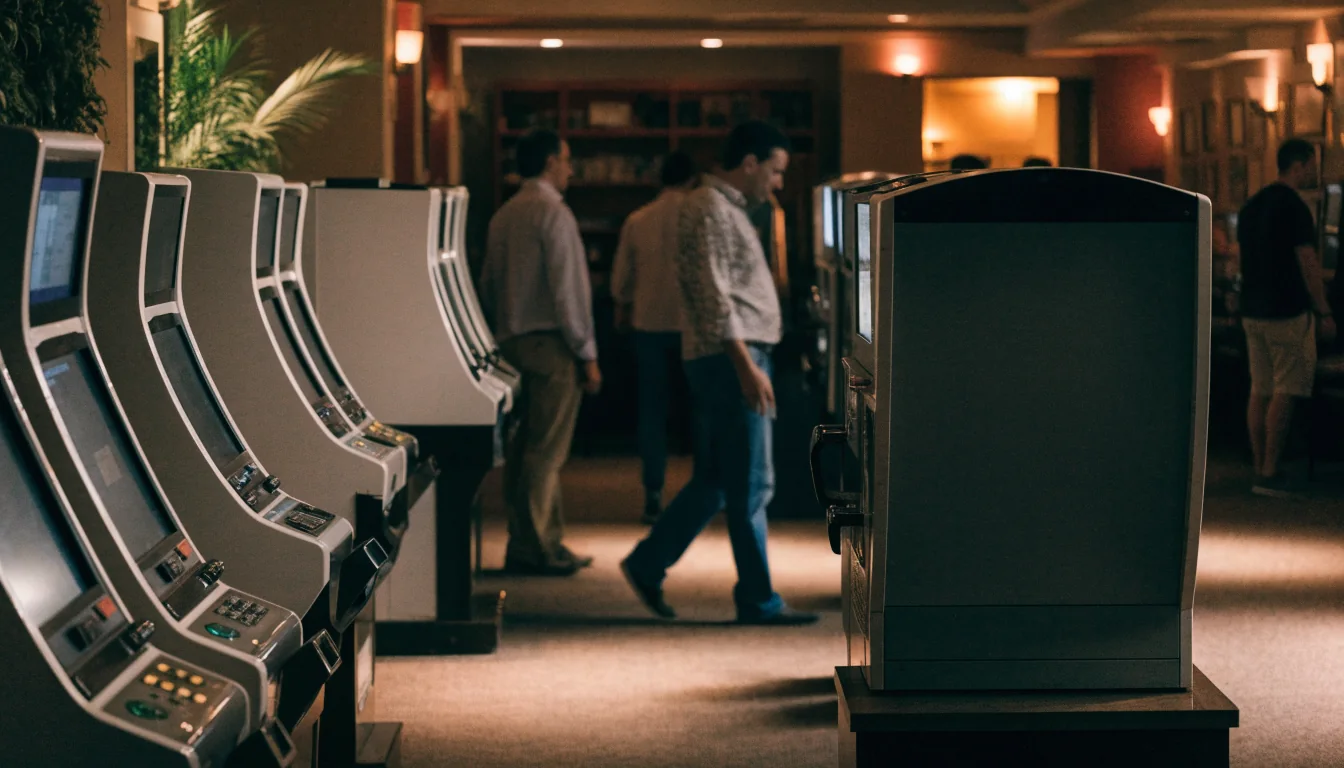
Lightning Link is a game series made by Aristocrat, the Australian developer. In Australia, it is played on machines at venues. It is not offered online for real-money play to Australian players. That distinction matters because the same name can suggest two different settings: a physical venue and an online casino. Only the first describes Lightning Link’s availability here.
The word “casino” often travels loosely in everyday language. It can mean a venue, a style of game, or an online service, even though those settings are not interchangeable. Calling Lightning Link a casino game may describe its category, but it does not mean an online casino in Australia carries the original game for cash play. The title belongs to Aristocrat’s venue-based series; its presence on a screen in a venue does not make it an online product.
That distinction can be easy to miss when a familiar name appears beside phrases such as “online pokies” or “casino games”. Such wording can make the original title sound as though it is available through an internet account. In the Australian context, that is not the case for real-money play. Lightning Link remains a venue-machine game, not an online casino offering for Australian players.
Choosing a Lightning Link online pokies site is about finding an operator whose known details suit your preferences. This shortlist gives you a concise reference point before you decide where to play.
WinSpirit Casino
WinSpirit Casino lists a Curaçao eGaming OGL licence, issued through Antillephone N.V. Its minimum deposit is A$30.
Ricky Casino
Ricky Casino lists crypto payouts in under an hour and PayID payouts in 1–3 business days. The minimum deposit is A$20, or A$30 to qualify for the bonus.
Uptown Pokies
Uptown Pokies operates under a Curaçao licence and has been operating since 2017. Its minimum deposit is A$20.
Lucky Dreams
Lucky Dreams lists a Curaçao licence and a A$20 minimum deposit when using POLi.
JustCasino
JustCasino lists a Curaçao Gaming Control Board licence.
SkyCrown
SkyCrown lists a Tobique Gaming Commission licence. Its stated payout times are around 10–15 minutes for crypto and 1–5 days for fiat, with a A$30 minimum deposit.
Roby Casino
Roby Casino lists a Curaçao eGaming licence under Roby Games Ltd.
Golden Pokies
Golden Pokies lists a Curaçao licence.
Bizzo Casino
Bizzo Casino lists a Curaçao Gaming Control Board licence under TechSolutions Group N.V.
Thor Casino
Thor Casino lists a Curaçao licence issued through Antillephone N.V. for Versus Odds B.V. Its minimum deposit is EUR 20.
There is a small cultural history in that difference. A game made by an Australian developer is encountered in Australia in a distinctly physical setting: as part of the country’s venue landscape, rather than as a product delivered directly to a household through an online casino. The machine and the place around it are part of the game’s local identity. The name may circulate widely, but availability is less elastic than language.
That does not make every online title with casino-style presentation the same product. A name, a theme or a resemblance in format cannot by itself establish that a particular online game is Lightning Link. The relevant point here is narrower: the original Aristocrat series is played on venue machines in Australia and is not offered online for real money to Australian players. The distinction is about where this particular game is available, not about every game that may share a visual or mechanical idea.
The phrasing “Lightning Link online casino” therefore describes an expectation rather than an Australian real-money option. The same is true of requests for Lightning Link online pokies or a Lightning Link casino game available over the internet. Those phrases may join familiar terms, but they do not change the product’s setting. In Australia, the named series belongs to venue machines.
This boundary is also useful when reading descriptions of casino-style games. “Online” can refer to a game that runs on a phone or computer, while “Lightning Link” names a specific Aristocrat series. Combining the terms does not establish that the specific series is offered online. The more precise description is less dramatic: a venue game, made by an Australian company, available on machines in Australia.
 Live Baccarat Online in Australia: How It WorksLearn how streamed baccarat differs from RNG play, how card variations and table rules shape a session, and what to check about…
 Live Roulette in Australia: Dealer Claims and Legal LimitsThe Interactive Gambling Act 2001 prohibits real-money online casino services to people in Australia; dealer and roulette-site claims remain unverified.
For people encountering the title in a venue, its national origin may make it feel like a local fixture. Yet being developed in Australia and being offered online to Australians are separate facts. One is about who made the game; the other is about the channel through which it can be played. Here, the first is Aristocrat, and the second is venue machines rather than real-money online access.
This page is affiliate-linked and may contain sponsored recommendations. That disclosure does not change the availability described above, nor does it turn an online casino reference into an offer to play. Real-money gambling content is for adults aged 18 or over.
The tidy version is also the accurate one: Lightning Link is an Aristocrat series played on venue machines in Australia. It is not an Australian online casino game for real-money play. The name may suggest several settings; the game itself has one.
“Free play” describes a different kind of arrangement from wagering money. On social platforms, pokies-style games may use virtual currency instead of cash stakes. The distinction is not cosmetic: under the Interactive Gambling Act, those games are not treated as gambling when players cannot win real money. A screen can borrow the look of a casino without carrying the same financial exchange.
Under the Interactive Gambling Act, games using virtual currency instead of cash stakes are not treated as gambling when players cannot win real money.
That line matters because the word “free” can cover several experiences. A game may let someone start without paying, then offer optional purchases of virtual currency or other in-app items. Another may provide a limited supply of tokens that refreshes over time. In either case, the defining feature of the social format is that play does not produce real-money winnings. It is not a route from virtual credits to cash.
The phrase “Lightning Link free play” can therefore refer to an online game that resembles the broad idea of a pokies session, not necessarily to the original Aristocrat product or an authorised digital version of it. Names and imagery can travel farther than the product itself. A title that invokes familiar terminology still needs to be understood by what it actually lets people do: use virtual currency, or stake and potentially win money. The former is social play; the latter is a different matter.
Virtual credits change the emotional texture of a game, but they do not make the interface meaningless. Counters rise and fall, animations signal success or failure, and a session can still be absorbing. What disappears is the financial result. A balance of in-game currency is not a cash balance, and a larger virtual total does not amount to a payout. The social format offers play as an activity, rather than a way to earn.
 Online Pokies E-Wallets in Australia: Offshore ContextLearn how e-wallets relate to offshore pokies, AUD deposits and withdrawals, bonuses and app risks. The Interactive Gambling Act places the prohibition…
 Inclave Casinos in Australia: Legal ChecksLearn why an Inclave sign-in does not prove Australian licensing, and how the Interactive Gambling Act 2001 applies to real-money online casino…
That separation can be easy to overlook when a game borrows the language and visual habits of gambling. The familiar vocabulary may suggest that the same stakes are present. They are not. The legal distinction described by the IGA rests on the absence of real-money winnings, not on whether a game looks convincing or imitates a commercial pokies experience. Appearance may invite comparison; it cannot change the underlying exchange.
Free versions can also sit within a commercial app environment. “Free” does not necessarily mean that every feature is available without purchase, nor does a social game’s availability turn it into a source of income. Those are separate questions from whether the game is gambling under the Act. The relevant boundary remains the possibility of winning real money. Where that possibility is absent, virtual-currency play falls outside the IGA’s gambling category described here.
This is why the expression “play Lightning Link online for free” needs care. It can mean a no-stakes social experience that uses virtual credits, or it can be used loosely to suggest that the original venue game has simply moved online. Those are not interchangeable claims. Free social play should not be confused with real-money access, and a familiar title or visual style is not evidence that a cash-wagering version is available.
The absence of cash winnings is also not a small-print qualification to a financial opportunity. It is the central feature that separates the social format from gambling. Virtual currency may keep a game moving, but it cannot turn a session into a payout. In that sense, free play is less a cheaper version of wagering than a different category of activity. The distinction is plain, if the interface is not.
This page is affiliate-linked and may contain sponsored recommendations; that disclosure does not change the distinction between virtual-currency play and real-money gambling. Anyone accessing real-money gambling content must be at least 18 years old. Social games using virtual currency are not a substitute for real-money winnings, and they should not be described as if they were.
A free online version may be suited to people interested in the style of play without financial stakes. Its value is the experience of using a game, not the prospect of converting virtual credits into money. That difference is not a technical footnote. It is the whole boundary.
Lightning Link is an Aristocrat game series whose identity rests less on a single image than on a change in pace. The Hold and Spin feature interrupts the ordinary sequence of spins with a different arrangement: positions occupied by special symbols stay fixed, while the remaining positions spin independently. A specialist game review describes this locked-and-moving pattern as the feature’s central mechanic.
The contrast is simple, but it changes how the screen is read. In a standard spin, the whole arrangement appears to move as one event. During Hold and Spin, some parts stop and become anchors; other parts continue to change around them. The eye is drawn back to the spaces that remain unsettled. The feature therefore creates suspense through divided motion, not through a complicated set of instructions.
 Live Blackjack Online in Australia: Legal ContextLearn how Australia’s Interactive Gambling Act 2001 treats real-money online blackjack and why a live table or polished site does not indicate…
 Plinko Casino in Australia: Games, Rules and RisksExplore how digital Plinko differs from an arcade board, and what to check around Australian rules, withdrawals, bonuses and free play.
That rhythm gives the series its name recognition among people who encounter it as a venue game or hear it discussed as a pokie. “Hold” describes the retained positions; “Spin” names what continues elsewhere. The terms are functional rather than mysterious. Their pairing tells the player that the feature is neither a complete reset nor a fully settled screen, but a temporary coexistence of fixed and changing elements.
There is a small theatre in that arrangement. A locked symbol becomes a point of reference, while the independent spins keep the surrounding spaces unresolved. Attention moves between what has already appeared and what may still change. The screen divides time into two kinds: a pause around the held positions and continued motion in the rest. That distinction is the feature’s design logic.
The effect is also legible without a long explanation. A player can see that some positions have stopped responding while others remain active. The mechanic does not require the whole screen to be decoded at once; its central contrast is visible. That clarity matters in a format built around repeated visual events. The game can make a distinct moment out of the relationship between stillness and movement, rather than relying only on a new setting or decorative theme.
This is why Hold and Spin is more than a label attached to a bonus. It supplies a recurring grammar for the series: certain positions are retained, and the others are treated separately. The special symbols are not simply part of the same uninterrupted motion as everything around them. Their positions acquire a different status for the duration of the feature. The remaining positions keep the scene open.
The feature creates suspense through divided motion by combining two states: held positions that act as anchors and independent spins that remain unresolved.
The word “independently” is important here. It means the moving positions do not behave as one single block merely because they share the same screen. The locked positions remain fixed, and the others spin separately. The point is not that each movement carries a promise; it is that the feature separates what is held from what is still in motion. Mechanics can create anticipation without making any particular outcome certain.
A familiar rhythm can become part of a game’s cultural footprint. People remember not only a title or a cabinet, but the moment when ordinary movement gives way to a recognisable pattern. In Lightning Link, that pattern is a visual pause threaded through continuing motion. The design asks the eye to keep two states in view at once. Stillness and change, side by side.
The feature’s name is therefore unusually plain for a piece of entertainment design. It describes the action rather than dressing it up. Hold and Spin: a compact instruction for a divided screen, and a compact account of why the series feels different from a continuous sweep of motion. The phrase does not explain every part of the game. It does explain its signature rhythm.
This article is affiliate-linked and may include sponsored recommendations. Real-money gambling content is restricted to adults aged 18 and over.
A Lightning Link machine has a practical price of entry: the amount selected for each spin. A specialist review reports minimum bets ranging from $0.20 to $1.00, with the setting dependent on the venue and the game variant. That range is a reported snapshot, not a fixed Australian standard. The machine in front of a player may have different options.
The distinction matters because “minimum bet” sounds like a property of the game, as though every Lightning Link machine came with one universal starting point. In practice, the figure can vary with the particular installation and version. A figure quoted in a review can therefore help describe the scale of play, but cannot establish what a machine at a particular venue will offer. The machine’s own displayed settings are the relevant ones.
Small numbers can make a session look modest. They do not make its cost predictable. A per-spin amount is only one part of the arithmetic; repeated spins turn that amount into a larger total, and the speed of play can make the accumulation easy to overlook. That is not a special trick of Lightning Link. It is the ordinary consequence of pricing gambling one turn at a time.
The venue setting also changes the meaning of comparison. A person looking at two machines may see the same game family but encounter different bet choices. A variant may have its own configuration, while the venue determines which machine and settings are available there. A review’s description of one setup should not be treated as a promise that every venue has the same menu.
This is why a Lightning Link machine review can be useful only when read narrowly. It may report a minimum observed or described for a particular variant or setting; it cannot substitute for the information on the actual machine. Nor does a lower starting bet tell anything by itself about how often a feature appears, what a session will cost, or whether a player will leave ahead. Bet size is a price, not a forecast.
Attention: Minimum bet figures quoted in reviews are snapshots and may vary by venue or game variant; always check the machine's own displayed settings.
The same caution applies to talk of the “rules” of a machine. The bet selector concerns the amount placed on a spin; it does not turn the game into a system whose outcome can be managed by choosing a particular stake. The hold-and-spin feature belongs to the game’s mechanics, while the bet control sets the scale of the wager. Neither changes the basic uncertainty of a gambling outcome.
A machine’s stated minimum is therefore best understood as a boundary, not a recommendation. The reported range gives a sense of the amounts encountered in descriptions of Lightning Link, but the venue and variant matter, and the local display settles the question for that machine. There is no reliable inference from a low minimum to a better chance of a favourable result.
That small distinction says something about how gambling is presented in public places. A single spin is made legible as a small transaction; the longer sequence of spins is less visible, though it is the sequence that determines the total spent. The interface makes the next choice prominent. The running total is easier to forget.
Lightning Link is a land-based venue game, not a real-money online offering for Australians. The figures above concern reported machine bet settings, not an online version or an invitation to play. This content is affiliate-linked and may contain sponsored recommendations. Real-money gambling content is for people aged 18 or over.
 Online Pokies Australia: Real-Money No-Deposit OffersLearn how offshore no-deposit offers work, why free spins may not mean cash, and how Australia’s Interactive Gambling Act treats real-money casino…
 Bonus-buy slots in Australia: how the feature worksLearn how bonus buys change entry to a round, what demo play can show, and why each spin remains independent under the…
The question of Lightning Link for real-money play in Australia sits inside a broader legal boundary. The Interactive Gambling Act 2001 prohibits operators from providing certain online gambling services to people in Australia, including online poker and casino-style games. The law is concerned with the service being supplied, not with whether a particular title is familiar from a venue machine. A familiar name does not create an exception.
That distinction matters when an online offer is described as Lightning Link, or as a similar Aristocrat game. A real-money online service of this kind is not a lawful Australian casino offering simply because it can be reached through a website or app. Nor does the legal position turn on claims about a demo, strategy or resemblance to a physical game. The relevant issue is the provision of a prohibited service to people in Australia.
The Act places its prohibition on operators. Australian players are not the people it makes liable for using an offshore gambling site, and there are no known cases of players here being prosecuted for doing so. That is a narrower reassurance than a claim that offshore sites are approved or protected: they are not thereby made lawful providers. The law draws its line at supply.
The federal body charged with enforcing the Act is the Australian Communications and Media Authority (ACMA), which also monitors compliance with national interactive gambling rules. Its role is more practical than symbolic. Where a website supplies a prohibited service, or advertises one in Australia, ACMA may ask internet service providers to block access. A site’s disappearance from a local connection may therefore reflect an enforcement measure, rather than a technical fault or an ordinary change of address.
Legal Prohibition
The Interactive Gambling Act 2001 prohibits operators from providing online casino-style games to people in Australia.
ACMA says its enforcement actions have resulted in more than 1,455 illegal gambling and affiliate websites being blocked since November 2019. Reported totals for services that have withdrawn from the Australian market since enforcement began in 2017 do not match: one account puts the number above 210, while another gives a figure above 190. The disagreement is worth stating plainly; neither total turns withdrawal into permission to return under another label.
A search for Lightning Link online for real money can therefore lead to a legal question before it leads to a game. The same applies to terms such as “real-money pokies” or “Lightning Link slots”: wording on a page does not change the character of the service being offered. In Australia, online casino-style play for money is the prohibited category, while enforcement is directed at providers and can include blocking.
This page may contain affiliate links and sponsored recommendations. That commercial disclosure does not endorse or make lawful a prohibited gambling service. Real-money gambling content is for adults aged 18 or over; age does not alter the Australian prohibition on online casino services.
The word “app” can make a venue game sound as if it has simply moved into a phone. Lightning Link was designed for land-based venues in Australia; an app bearing a similar name or visual style is not evidence that Aristocrat’s original game is available for real-money play online here.
 High-Volatility Slots in Australia: How They WorkLearn how volatility differs from RTP, why large wins may take longer, and why each spin is independent of previous results.
 Low-Volatility Slots in Australia: How Wins BehaveLearn how low volatility shapes win frequency and size, and how it differs from RTP, bankroll duration and demo play. No spin…
A specialist review describes online platforms carrying games from Aristocrat and other developers that use a comparable Hold and Spin mechanic. Similarity is not identity. A shared feature may create a familiar rhythm, but the title, artwork, rules and platform can belong to a different game altogether. The developer’s name and the exact game title matter more than a loose resemblance.
That distinction also helps make sense of references to Happy Lantern. It is a Lightning Link variant associated with venue play, not a separate route to an Australian real-money app. A listing or video using that name does not, by itself, establish where a game can legally be played or whether it is the original product.
The market for phone entertainment is crowded with labels that borrow a recognisable game name, describe a similar mechanic, or offer a social version. Those labels can blur categories that should remain separate. A mobile title may be a different product; an online game may share a feature; neither changes the land-based status of Lightning Link in Australia.
The same caution applies to “tips”. Advice attached to an app or a similar game should not be treated as a method of accessing the venue game, or as a way to alter what a game will do. A title’s identity and platform are factual matters, not a matter of persuasive wording.
This page is affiliate-linked and may contain sponsored recommendations. That disclosure does not make prohibited online casino services lawful or turn a recommendation into an endorsement. Real-money gambling content is restricted to adults aged 18 and over; in Australia, online casino-style games cannot be offered legally to local players. The app label changes little. The platform does.
On linked Lightning Link machines, the Major and Grand jackpots are described in specialist game reviews as growing as players wager across the connected machines. The display gives that shared pool a visible presence: each person’s spin belongs to a local game, while the jackpot reflects activity across a network. It is a communal mechanism with an individual claim at the end, though the display cannot make the outcome predictable.
A specialist game review also notes that eligibility for a jackpot may depend on wagering at the maximum bet. That condition matters more than the headline figure. A player who chooses a lower stake may not qualify for the same jackpot, depending on the machine’s rules. The applicable terms are set for the particular venue game; a jackpot shown on screen is not evidence that every bet is eligible.
This is where “how to win” becomes a misleading frame. A larger wager may be a condition of eligibility, not a way to make a jackpot more likely or to secure a return. The Major and Grand are prize features, not a timetable. Their growth records wagers on linked machines; it does not tell anyone when a jackpot will be awarded.
The distinction is especially important when information about Lightning Link is encountered online. Similar names or jackpot language do not establish that the original venue game is available for online real-money play in Australia. Here, Lightning Link is played on venue machines. Real-money gambling is for people aged 18 or over, and this description is not an invitation to seek an online version.
 Real Money Casino Table Games in AustraliaCompare live-dealer streams with RNG tables, see how game formats shape play, and understand what “best odds” can—and cannot—mean.
 Mines Casino Game in Australia: What to KnowLearn how Mines differs from Australian pokies and what demo play, bonuses and cashouts can establish. The article cites reported Victorian losses…
The arithmetic of a maximum bet is plain; the result is not. A condition for eligibility can also mean a greater stake is exposed without any assurance of a prize. The screen may count upwards. It does not offer a forecast.
This article is affiliate-linked and may contain sponsored recommendations. That disclosure does not change the limits of what the jackpot display can promise.
On a venue machine, Hold and Spin changes the usual rhythm of a spin. A specialist game review describes its central action this way: positions occupied by special symbols stay fixed, while the remaining positions spin independently. The board becomes a mixture of stillness and movement rather than a single field turning as one.
That distinction matters to the way the feature unfolds. Once symbols are held in place, the changing positions are the only ones that can alter the display on the next spin. The locked symbols remain visible as the other positions resolve, making each new result easier to follow. The feature’s name is fairly literal.
This is a description of the machine’s play, not a guide to accessing Lightning Link online. Searches for an online version can blur the difference between a land-based game and other titles that borrow a similar mechanic. The original Lightning Link is played on venue machines in Australia; this account does not imply real-money online availability.
On a venue machine, the Hold and Spin feature makes the board a mixture of stillness and movement, where locked symbols remain visible while other positions resolve.
Nor does the feature itself establish what any result is worth. Hold and Spin describes how positions behave, not a promise of a payout or a route to one. The machine’s sequence can be understood without treating its animation as evidence of likely success. A flashing display is still a display.
This page is affiliate-linked and may contain sponsored recommendations. That disclosure does not change the distinction between describing a venue game and promoting online gambling. Real-money gambling content is restricted to people aged 18 or older.
In practical terms, the feature asks the eye to track two things at once: the symbols that have stopped moving and the positions still spinning. That is the whole trick, mechanically speaking. The still positions provide continuity; the moving ones supply the changing outcome. No more elaborate explanation is needed to understand what happens on the screen.
A request for a downloadable Lightning Link can sound like a simple matter of finding the right file. It is not. Lightning Link was designed for land-based venues, and the original game is played on venue machines in Australia; a download label does not turn it into an Australian online real-money offering.
The name points to a particular Aristocrat game series, but online titles may borrow its most recognisable idea without being the same product. Specialist game reviews describe online platforms offering similar Hold and Spin mechanics from Aristocrat and other developers. Similarity of play is not proof of an official Lightning Link release, nor does it establish that a title is available for real-money play in Australia.
“Lightning Dollar Link” can be another way a title is described or sought, but the words alone do not verify the game’s identity or its source. A page offering a file under that name may refer to a different title, a social game, or an unauthorised copy. The distinction matters: a familiar name can travel further online than the machine it names.
A download, where one exists, should therefore be understood by what it actually contains—not by a promise implied by the label. Similar mechanics do not make two games interchangeable.
This page is affiliate-linked and may contain sponsored recommendations. That disclosure does not change the legal position: real-money online casino-style games are prohibited for operators serving people in Australia. Anyone accessing real-money gambling content must be at least 18; this is not a recommendation to seek an online casino game.
A specialist review identifies Happy Lantern, Magic Pearl, Sahara Gold and High Stakes among the commonly encountered Lightning Link variants. The names suggest separate themes, but the meaningful distinction is not merely visual: each version has its own paytable and bonus features. A familiar title therefore does not guarantee an identical set of play rules across machines.
That matters because Lightning Link is a series, not one fixed configuration. A venue’s particular machine may present a different combination of symbols, bonus details and listed payouts from another version. The variant name is a useful label, but the machine’s own information is what describes that specific game. Similar branding is not a promise of identical outcomes.
The four names offer a small map of the series: lanterns, pearls, desert gold and a high-stakes theme. They are examples reported in specialist coverage, not a definitive catalogue of every configuration in circulation. Paytables and bonus features vary; those differences should not be collapsed into a single description of Lightning Link.
This distinction is also why online titles with related mechanics should not be mistaken for these venue variants. A shared feature or theme does not make another game the same product.
This page is affiliate-linked and may contain sponsored recommendations; that disclosure does not change the legal status of gambling services in Australia. Real-money gambling content is restricted to adults aged 18 and over.
The Interactive Gambling Act prohibits operators from providing certain online gambling services, including casino-style games, to Australian residents. The law targets operators rather than individual players, and there are no known cases of Australian players being prosecuted for gambling on offshore sites.
You may find social pokies-style games that use virtual currency, but those credits cannot be won as real money. That does not make the online game the original Aristocrat Lightning Link, which is played on venue machines in Australia.
No. Lightning Link is a venue-machine series, while online games with similar Hold and Spin mechanics are separate titles and should not be assumed to be the same game.
Online casino-style services are prohibited from being provided to Australian residents under the Interactive Gambling Act, so these bonuses are not an offering from a legal Australian online casino.