The phrase does not establish a venue or its regulator; this guide explains casino licensing, entry details, online claims and bonus language.
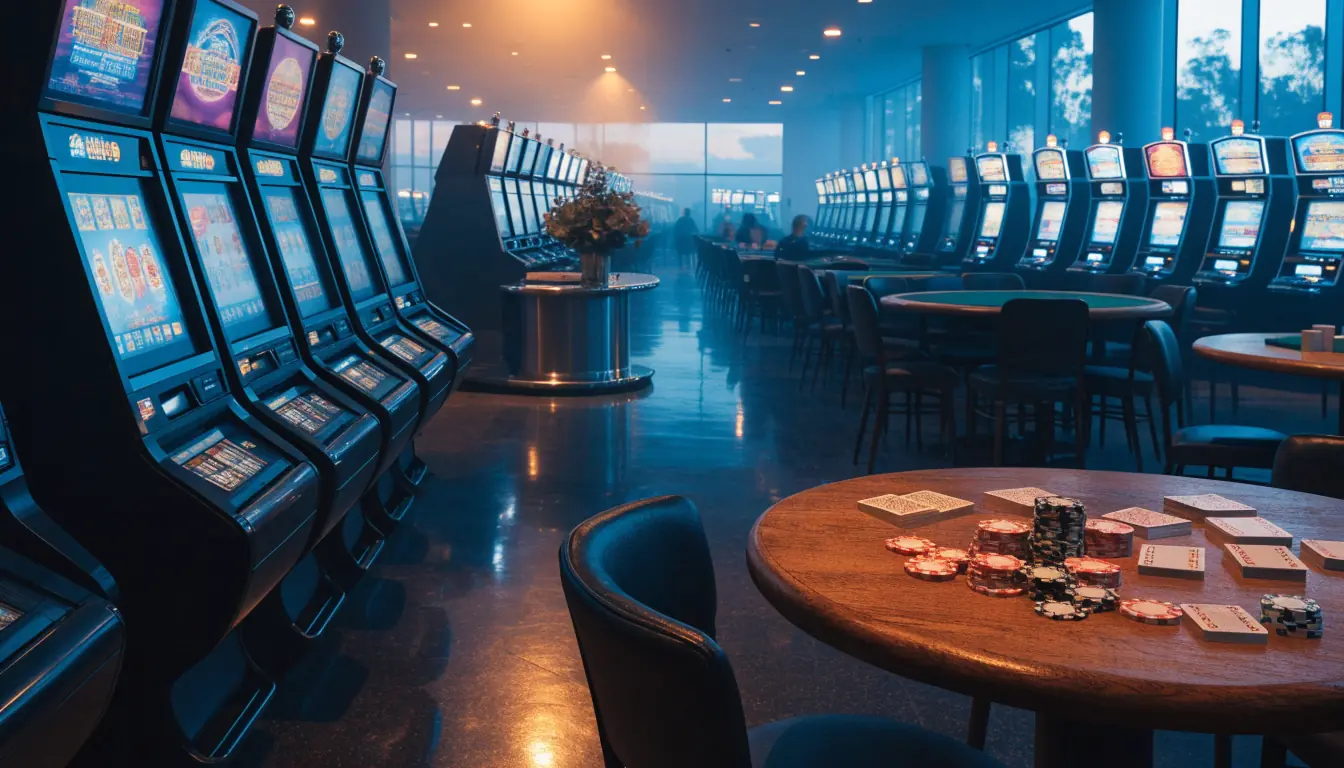
In Australia, “pokies parlour” sounds like a compact kind of venue: a room, perhaps, organised around a particular form of gambling. But the phrase does not describe a separate national class of casino. It is informal language, while the country’s established casino landscape consists of full-scale properties operating under licences issued by the state or territory in which each one is located. The distinction is less about the words on a sign than about the scale and regulatory framework they imply.
That matters because Australian gambling vocabulary is unusually good at making unlike things sound alike. “Pokies” is a familiar local word for gaming machines; “parlour” suggests a smaller, more contained setting. Put together, the words may evoke a neighbourhood room dedicated to machines. They do not, by themselves, identify a licensed casino, establish that a particular venue exists, or explain which jurisdiction oversees it. A search phrase can be vivid without being a legal category.
The broader casino sector is not small. A specialist affiliate review describes Australia as having more than twenty full-scale casinos, distributed across all eight state and territory jurisdictions. That figure should be read as the review’s account, not as a permanent census: venues open, close, change hands and operate under arrangements shaped by local governments. The more durable point is structural. There is no single national casino licence that turns every property into the same kind of place. Each casino’s authority comes from its own jurisdiction.
Choosing a pokies parlour casino in Australia is easier when you can quickly check the concrete details available for each option. Use these verdicts as a starting point, and review the relevant terms before signing up.
WinSpirit Casino
WinSpirit Casino lists a Curacao eGaming licence, OGL/2024/923/0383, issued through Antillephone N.V. Its minimum deposit is A$30.
Ricky Casino
Ricky Casino lists crypto payouts in under an hour and PayID payouts in 1–3 business days. The minimum deposit is A$20, or A$30 to qualify for the bonus.
Uptown Pokies
Uptown Pokies operates under a Curacao licence and has been operating since 2017. Its minimum deposit is A$20.
Lucky Dreams
Lucky Dreams lists a Curacao licence and a A$20 minimum deposit when using POLi.
JustCasino
JustCasino lists a licence from the Curacao Gaming Control Board. No deposit or payout details are provided here.
SkyCrown
SkyCrown lists a Tobique Gaming Commission licence. Its stated payout times are around 10–15 minutes for crypto and 1–5 days for fiat; the minimum deposit is A$30.
Roby Casino
Roby Casino lists a Curacao eGaming licence held by Roby Games Ltd. No other details are provided here.
Golden Pokies
Golden Pokies lists a Curacao licence. No further operator details are provided here.
Bizzo Casino
Bizzo Casino lists a Curacao Gaming Control Board licence, with TechSolutions Group N.V. named in connection with it. No deposit or payout details are provided here.
Thor Casino
Thor Casino lists a Curacao licence through Antillephone N.V., with Versus Odds B.V. named in connection with it. Its minimum deposit is EUR 20.
This arrangement reflects a wider Australian habit of governing gambling through a patchwork of local rules rather than one uniform national venue system. The federal government has a role in particular areas, but the licensing of physical casinos belongs to states and territories. As a result, “casino” is not simply a building type. It is also a regulated status, attached to a property through the relevant local licence. The word “parlour” cannot substitute for that status, however confidently it is used in advertising or casual conversation.
The numbers attached to casino gaming machines also show why a small-sounding label can obscure a much larger system. Across Australian casinos, venue licences endorse a total of 3,308 gaming machines that are installed on casino premises. That national figure says something about the scale of the licensed casino environment; it does not mean that every casino has the same number, or that a “pokie parlour” is a recognised subdivision of it. A national total is not a floor plan.
The terminology also carries a social history. “Parlour” belongs to a language of rooms and leisure, while the Australian shorthand “pokies” makes the machinery sound domestic and familiar. Familiarity can soften the edges of an industry that is, in practice, closely tied to venue licences and public regulation. The everyday word suggests an ordinary pastime; the legal structure insists on a regulated property. Both meanings circulate at once, though only one determines whether a casino is authorised to operate.
 Best Pokies in Melbourne: Venues, Hours and RulesExplore how to judge proximity to Melbourne Airport, check venue hours and understand what “best paying” can mean, alongside local rules and…
 Best RTP Pokies in Australia: How to Read the FiguresLearn how RTP describes returns across extensive play, why the same pokie may show different figures, and why it cannot predict a…
This is why the phrase “casino parlour” can lead to confusion. It may be used loosely to describe a casino gaming area, or it may simply be a label assembled from familiar gambling terms. Neither use establishes that Australia has a separate network of parlour casinos alongside its full-scale casinos. Nor does the phrase tell anyone whether a venue is a casino, another kind of gaming venue, or merely a description chosen to attract attention. The name alone settles very little.
The distinction is particularly important in a country where gambling facilities are not all governed under one national template. A physical casino’s licence belongs to its state or territory, and the property operates within that local framework. The national picture is therefore made up of separate jurisdictions, not one central list of parlours with a common legal identity. That may be less tidy than the phrase suggests. It is also more accurate.
So, in Australian usage, a “pokie parlour” is best understood as informal wording, not as proof of a distinct casino category. The recognised landscape is the licensed, full-scale casino sector, whose properties answer to their own jurisdictions. The smaller phrase may be convenient; it does not make the underlying system smaller.
Australia’s gambling geography is not a simple map of major cities with a casino pinned to each centre. Gambling activity is counted across a broader range of places, while large urban populations, tourism and state boundaries shape where facilities cluster. A specialist gambling-directory review puts the number of Australian cities with gambling at 147. That figure describes the review’s own count, not a permanent national register: the category depends on what it includes, and the landscape can change.
The distinction matters because a city count is not a casino count. “Gambling” can cover different kinds of facilities and activity, so the number cannot be read as meaning that every place in the tally has a full-scale casino. Nor does a wide distribution imply that gambling is evenly spread. A national total gives breadth; it says little by itself about concentration, scale or the role a venue plays in local life.
Sydney illustrates that unevenness. The same kind of specialist directory review identifies it as Australia’s largest gambling city and assigns it 11 gambling facilities. This is a count attached to a particular method of classification, rather than a timeless measure of the city. Still, it offers a useful contrast with the national picture: activity may reach many cities, while one metropolitan centre holds a notably dense concentration.
Such concentration has a social geography as well as a physical one. Large cities bring residents, visitors, transport links and entertainment districts into close proximity. Gambling facilities sit within those patterns, not outside them. Their distribution reflects decisions made by governments and operators, and the boundaries of the jurisdictions that license gaming venues. Australia’s states and territories regulate casinos separately, so the national map is also a patchwork of local rules and local choices.
 Best pokies in Canberra: hours and local checksA venue’s public timetable may differ from its gaming-room schedule. Learn what local listings can—and cannot—confirm about machine access.
 Aussie pokies online: free play and real stakesLearn how free-play credits differ from money at risk, and how offers, payment routes and offshore access complicate Australian online pokies.
That patchwork complicates comparisons. A count of cities says where some form of gambling has been recorded; a count of facilities says something about density; neither explains how much activity takes place, who participates or what a particular venue means to its neighbourhood. Numbers can orient the map, but they cannot supply its human scale. A city label may conceal very different settings, from a major metropolitan entertainment district to a smaller community with a limited range of venues.
The phrase “Australian gambling map” therefore describes several overlapping geographies: the spread of activity across urban centres, the concentration of facilities in particular cities, and the jurisdictional lines that determine how venues are governed. Sydney’s reported position is a point of concentration within that larger pattern, not a summary of the country. The national count, meanwhile, is a directory’s snapshot, not a civic census.
Seen this way, a pokies parlour in Australia belongs to a broader landscape of regulated gaming venues, but the map does not make every place alike. Distance, density and jurisdiction all matter. The figures provide bearings, not a verdict on any city or its residents. The map is uneven.
The practical meaning of a “pokies parlour” varies with the place being described. In Australia, casino access is tied to identifiable venues, each operating within its own physical setting. Lasseters Casino sits at 93 Barrett Drive in Alice Springs, Northern Territory. On the Gold Coast, Jupiters Gold Coast Casino & Hotel occupies Broadbeach Island. In Meander Valley, Tasmania, Country Club Casino’s address is Country Club Avenue, Prospect.
Located at 93 Barrett Drive in Alice Springs, Northern Territory.
Occupies Broadbeach Island on the Gold Coast.
Located at Country Club Avenue, Prospect, in Meander Valley, Tasmania.
Opening hours need to be read at venue level. Major Australian casinos operate around the clock, but a published schedule for a particular facility may describe other parts of its operation. One venue’s information says it opens at 9am each day and closes from 3am until noon on ANZAC Day. That schedule should not be mistaken for a universal timetable: the distinction between a casino’s gaming floor and its wider facilities matters.
Age rules are less variable. Casino entry is restricted to people aged 18 or over nationwide. A venue may allow accompanied under-18s into restaurants or selected entertainment areas, but that is not permission to enter the casino itself. The threshold marks a boundary between public hospitality and gambling, even where both sit under one roof.
Physical details can therefore answer a different question from the loose image suggested by “parlour”: where a venue is, when its doors or facilities operate, and which areas are accessible. The wording may sound small-scale; the premises may be a hotel complex or a major casino. A modest label does not make the rules modest.
A website can load, display a sign-in page or accept account traffic without being authorised to provide online casino gambling in Australia. The same is true when its address changes. A functioning page proves that a page is reachable at that moment; it does not prove that the service has an Australian licence. On this point, appearance is a poor guide.
The legal position is more fundamental than a question of licensing. Under the Interactive Gambling Act 2001, operators must not provide real-money online casino games to people in Australia. That prohibition covers casino-style offerings such as poker, blackjack, roulette and slots. A foreign licence, a familiar brand or a newly registered web address does not turn such a service into a lawful Australian online casino.
The distinction between an address and an authorisation matters because internet access is not static. When a domain is blocked, an operator or an associated service may appear under another address. Australian internet providers can be asked to restrict access to sites supplying prohibited interactive gambling services or advertising them locally. A changed address may therefore explain why a page appears again; it does not establish that the service has changed its legal status.
The federal regulator in this area is the Australian Communications and Media Authority, or ACMA. It administers enforcement of the Interactive Gambling Act and monitors compliance with federal rules for interactive gambling. Where prohibited services are involved, ACMA can ask Australian internet service providers to block the relevant websites. Blocking operates at the level of access, not as a certificate of what lies behind a domain.
This makes the alternate address a particularly unhelpful reassurance. It can create the impression of continuity: the same graphics, familiar account details, perhaps the same language about a casino experience. But continuity of presentation is not proof of local approval. Nor does an account that accepts traffic show that the operator is permitted to serve people in Australia. A site’s technical availability and its legal position are separate matters.
Legal Prohibition
Under the Interactive Gambling Act 2001, operators must not provide real-money online casino games, such as poker, blackjack, roulette and slots, to people in Australia.
ACMA’s enforcement record gives this distinction public weight. Following enforcement actions, the agency has blocked more than 1,455 illegal gambling and affiliate websites since November 2019. Those blocks are part of a continuing effort to limit access to services that breach Australian rules, rather than a declaration that every blocked address represents the same operator or conduct. Domains can change; enforcement is directed at services and the activity they provide or promote.
There is also a reported difference in the count of illegal services that have left the Australian market after enforcement began in 2017. One account puts the figure above 210; another reports more than 190. Both descriptions, however, refer to services withdrawing after ACMA enforcement began.
The larger point is not that a particular page will always be unreachable, or that every alternate address is identical. It is that a website’s ability to appear is not a test of legality. In a market where real-money online casino services are prohibited, a working link cannot supply the permission the law withholds. The address may move. The boundary does not.
“No-deposit” and “sign-up bonus” belong to the vocabulary of inducement. One phrase suggests that a benefit arrives without an initial payment; the other attaches a reward to opening an account. Together, they can make an online casino sound less like a gambling service and more like a welcome desk with a gift on it. The wording is familiar because it turns a commercial invitation into an apparent act of generosity.
That impression deserves distance. A phrase describing an offer is not evidence that the offer exists, that its terms are as the headline implies, or that the service may lawfully provide online casino games in Australia. Nor does a claim become reliable merely because it appears on a page that looks orderly or accepts account traffic. Presentation and legal status are different questions.
The distinction matters especially in Australia. Under the Interactive Gambling Act 2001, operators cannot provide real-money online casino games to people physically in the country. A sign-up incentive does not alter the nature of the service attached to it. Calling it a welcome reward, a no-deposit benefit or a casino bonus does not turn prohibited online casino gambling into something else.
The language itself often compresses several separate claims. “No deposit” may be read as a statement about what is required before an account can be opened, while “sign-up bonus” can imply a benefit linked to registration. Neither phrase, on its own, explains what the offer consists of or what conditions would apply. More importantly, neither establishes that an Australian-facing casino service is legitimate. A headline is a sales device, not a licence.
This is where the word *free* can do quiet work. It draws attention to what appears to be given and away from the service being promoted. The offer may sound like the main event, although its commercial purpose is to encourage attention or participation. Such language is not unusual in advertising; what matters is the product behind it. In this case, an incentive attached to real-money online casino games cannot make the underlying service lawful for Australian customers.
The phrase “pokies parlour sign-up bonus” also merges two settings that should not be confused. A physical gaming venue and an online casino promotion are not interchangeable simply because both use familiar gambling language. A parlour-like label may lend a local, approachable feel to a web page, while the bonus wording gives it the tone of an invitation. Neither label proves that the page represents an Australian casino facility or a service authorised to offer online casino play.
Even the appearance of a specific offer does not settle basic questions about who is making the claim and what service it relates to. A web page can state that an incentive is available; that statement remains a statement by the page. It is not independent confirmation of the offer, the operator’s standing, or the legality of the gambling activity. Accessible pages and active account processes do not establish Australian licensing.
This is not a technical quibble about wording. Incentives shape how people approach a service: attention moves towards the apparent benefit, while the more consequential question—what is being offered and under which legal framework—can recede. A zero-entry price, implied or explicit, can make a commercial proposition feel unusually low-risk. The feeling is not evidence.
Australian law draws its boundary around the provision of real-money online casino games, not around the charm or size of an accompanying inducement. The offer language may vary; the underlying activity does not. A “no-deposit” label cannot serve as a workaround, and a sign-up claim cannot confer a status the service does not have.
The sober reading is therefore a narrow one. These phrases describe promotional framing, not verified permission to gamble online in Australia. They say what a page wants its offer to sound like. They do not establish that an Australian-licensed online casino exists behind it, or that the promised benefit changes the legal position. The wrapping is not the service.
“Free spins” and “free chips” sound like small gifts, the sort of language that makes gambling appear to begin before any decision has been made. In practice, the words are labels, not evidence. They do not establish that an offer exists, that it comes from an Australian venue, or that a website is authorised to provide what it describes.
The distinction matters because “casino” can refer to a physical property or be used loosely in online promotional copy. A phrase promising complimentary play does not turn a website into an Australian casino, nor does it show that a particular venue provides the promotion. Australian casino properties operate under licences issued by their respective state or territory jurisdictions. That local framework cannot be inferred from the tone of an advertisement.
Nor does the word “free” settle what is being offered. It may describe a promotional claim, a play feature, or simply wording designed to make a page feel generous. Without reliable information identifying the provider and the conditions, the phrase remains a claim. There is no need to assume that a benefit exists merely because its name is easy to repeat.
Online casino-style services are prohibited when offered to people physically in Australia, regardless of whether the activity is described as "free spins" or "free chips.
The same caution applies to language about chips. In ordinary casino imagery, chips belong to the visual vocabulary of a gaming floor; online, the word can be used to imply a bonus or a balance. Those meanings are not interchangeable. A reference to chips does not establish that a physical venue is involved, while the appearance of an online balance does not prove that the service is a lawful Australian casino. Packaging is not provenance.
“Spins” can be made to sound equally weightless: a little extra activity, apparently detached from money or consequence. But a promotional label says nothing by itself about how a service is classified or whether it may be provided in Australia. Online casino-style services are prohibited when offered to people physically in the country. Calling part of that activity free does not create a different legal category.
There is also a basic evidentiary gap between a website and an Australian-licensed venue. A page may load, accept account activity or appear under another address; none of those circumstances establishes that it is licensed as an Australian online casino. A free-play claim cannot fill that gap. It is still only a claim attached to a page.
This is why free-chip and free-spin wording should be read as marketing language, not as a map of Australian casino facilities. It may tell something about the impression a page hopes to create. It does not verify a venue, a licence, or an available promotion. The distinction is less dazzling than the promise. More useful, too.
A review can describe a website, its design and the claims made on its pages. It cannot, by itself, turn those claims into proof of Australian licensing or local availability. That distinction matters especially when a review uses the language of a physical venue—“parlour”, “casino”, “open” or “available”—to describe an online service. Familiar words can lend a borrowed solidity to something that remains a website.
The Interactive Gambling Act 2001 prohibits operators from providing real-money online casino games to people in Australia. So a favourable write-up of an online casino is not evidence that the service is locally licensed. Nor does a polished review establish that the service has a lawful place in the Australian market. The existence of a page is one thing; its legal status is another.
Reviews are useful when read as descriptions of what their writers observed, rather than as certificates. A piece may report that a site loaded, that an account process appeared to work, or that a particular address was being used. Those details can describe an encounter at a particular time. They do not establish authorisation. A website being accessible, accepting account traffic or appearing under another domain does not prove it is an Australian-licensed online casino.
That gap is easy to miss because review writing often arranges information in the reassuring order of a consumer guide: a summary, a verdict, then practical details. The form can imply that the central question has already been settled. But confident language is a property of the prose, not evidence of the operator’s status. An assessment that gives a service a positive rating may still leave the most important question unanswered.
Domain changes make the distinction more conspicuous. A specialist review has described website blocking as affecting which domains resolve through Australian internet service providers, with alternate addresses appearing over time. That account concerns a changing technical situation, not a reliable test of legitimacy. A new address may explain why a page appears in one place and not another; it does not show that the service has become lawful or locally licensed.
The same care applies to claims of “Australian access”, local support or a site tailored to Australian users. Such phrases can describe presentation or intended audience, but they do not prove that an operator holds a licence permitting real-money online casino services in Australia. A review that repeats them without separating marketing language from legal status is reporting the pitch, not resolving the question.
A more careful review makes its limits visible. It distinguishes what was observed from what was asserted, dates claims that may change, and avoids treating a working address as a regulatory credential. It also makes clear whether it is discussing a land-based venue or an online service; the word “casino” can blur that boundary when used loosely.
The useful question is not whether a review sounds certain, but what its certainty rests on. If the evidence is simply that a page opened or an alternate address appeared, the conclusion should remain modest. A review can illuminate the language around a service. It cannot confer a licence.
A small distinction. A consequential one.
Bonus language can make an online casino sound like an ordinary retail business: a welcome, a reward, a little extra attached to opening an account. In Australia, that framing does not settle the more important question. The Interactive Gambling Act 2001 prohibits operators from providing real-money online casino games to people in the country, and advertising such services is also prohibited. A promotional label cannot turn a prohibited service into a lawful one.
The distinction matters because inducement language can travel farther than the legal context around it. A page may describe a bonus as a routine perk, or present it alongside polished branding and familiar payment language. Those details are not evidence that the underlying casino service is permitted in Australia. Nor does an affiliate’s endorsement change the regulatory boundary. The language of hospitality has limits.
The Australian Communications and Media Authority (ACMA) enforces federal interactive gambling rules and can act against operators that provide or advertise prohibited services. Its enforcement record includes website blocking: since November 2019, the authority has blocked more than 1,455 illegal gambling and affiliate websites following enforcement action. That scale includes both gambling services and sites that help promote them. The affiliate layer is part of the picture, not a decorative footnote.
There is also a reported difference in the count of illegal services that have left the Australian market since ACMA began enforcing the rules in 2017. One account puts the number at more than 210; another gives a figure of over 190. Those figures should not be collapsed into a single precise total. Both describe withdrawals following enforcement, but the disagreement means the count depends on which account is being used.
Blocking is a practical part of enforcement, though it does not make promotional claims reliable by itself. Domains can change, and a bonus page may remain visible or be repeated elsewhere even as action is taken against related services. Visibility is not authorisation. Neither is a reward described in persuasive prose.
That is the boundary bonus talk tends to blur. In a market where real-money online casino services are prohibited, the question is not whether a promotion sounds generous, exclusive or familiar. It is whether the service being promoted is allowed to reach people in Australia. ACMA’s actions against gambling and affiliate websites show that the regulator treats promotion as part of the problem, rather than as harmless commentary around it. The wording may be cheerful. The law is not.
“VIP” carries the suggestion of a separate door: a private tier, special treatment, perhaps a place apart from the ordinary run of casino life. In Australian casino language, though, it is not a formal category of venue. A phrase such as “VIP parlour” may describe the tone a searcher imagines, or the way a business presents an experience, but it does not establish that a distinct kind of casino exists.
The word has a long social life beyond gambling. Hotels, clubs and airlines use it to sort access and signal status; casinos inherit that vocabulary because status is part of the business’s theatre. The label can make an ordinary commercial distinction sound like a difference in kind. It cannot, by itself, establish who may enter, what is offered, or whether a place is authorised to operate.
The clearest nationwide boundary is less glamorous: casino entry is restricted to adults, with eighteen as the minimum age across Australia. That rule applies regardless of whether an establishment uses language about VIP access or presents itself as exclusive. A status label does not replace the age threshold, nor does it turn a casino into a members-only casino.
There is a useful distinction between exclusivity as a marketing idea and access as a legal condition. The first is made from words, design and social expectation. The second is grounded in the rules that govern entry. Confusing them gives promotional language more authority than it deserves.
A VIP claim, then, is not proof of a special venue class. It is a description to interpret, not a credential. The velvet rope may be real; the category may not be.
The phrase “real-money casino” carries a neat promise of a familiar transaction: an account, a balance and games played for cash. In Australia, that wording does not describe a lawful online casino service for people physically in the country. The Interactive Gambling Act 2001 prohibits operators from providing real-money online casino games to customers here, including slots and table games.
That boundary matters more than a polished site or a convincing local tone. A page may load, accept account traffic or appear under a different web address; none of those details proves that it is an Australian-licensed online casino. Access is a technical fact, not a licence. The distinction can be easy to blur when a site presents its services as ordinary entertainment, but presentation does not change the legal character of the service.
Australia’s system draws a firm line between physical casino venues, regulated by the state or territory where each property operates, and online casino-style play for real money. The existence of licensed venues on land does not create a local licence for an online version of the same games. Nor does a search result, a familiar brand name or a functioning account establish one.
The law is directed at operators providing prohibited services, not at imposing criminal liability on players for using an offshore casino. That difference should not be mistaken for an endorsement or a guarantee of safety. A real-money balance shown on a screen is still dependent on the site’s own arrangements, while Australian licensing cannot be inferred from the screen itself.
A precise distinction, then: online access may be visible; Australian licensing does not follow from it. The two are not interchangeable.