A guide to live-dealer and RNG formats, table-game differences, roulette wheels, poker hands and the limits of odds comparisons.
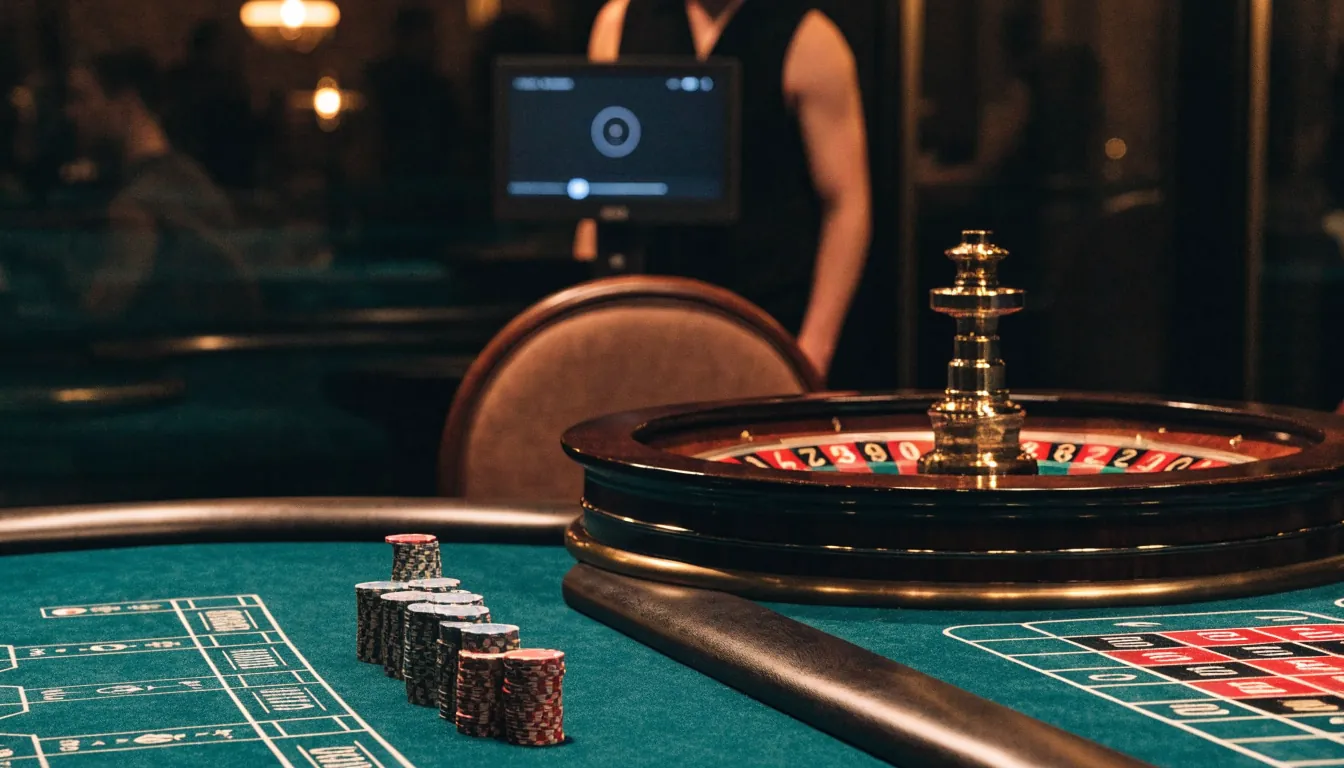
A table-game screen can present two quite different kinds of event. In one, a real dealer handles casino equipment and a live video feed carries the action to viewers. In the other, software determines the outcome: the cards dealt or the point at which a roulette ball appears to land are generated by a Random Number Generator, or RNG. Both may look like a table on screen. The machinery behind the image is not the same.
A live stream preserves some of the visible rituals of a physical casino: a dealer’s gestures, the movement of equipment, and the pauses between one stage of play and the next. The camera makes the table an observed place, even though the player is elsewhere. That sense of presence is part of the format; it does not turn the viewer into someone physically seated at the table.
An RNG version removes the dealer from the outcome. The software selects the result, and the screen represents it through cards or a simulated wheel. The animation may borrow the language of a casino table, but it is not evidence that a physical hand or ball produced the result. Here the table is a visual interface. The distinction matters less as a judgement of one format over another than as a description of what is happening.
The difference is easy to blur because the two formats can share familiar imagery. A digital dealer may appear beside an automated game, while a live game may present its stream within an interface crowded with buttons and figures. The surface can be similar; the source of the outcome is the useful dividing line.
 Casino Games & Apps for Australian PlayersThis page groups Australian casino searches by game format and app access, covering slots, crash and live dealer play alongside mobile options.
 High-Volatility Slots in Australia: How They WorkLearn how volatility differs from RTP, why large wins may take longer, and why each spin is independent of previous results.
In live dealer games, a real person and real casino equipment are filmed and streamed. In digital versions, an RNG determines the result. Neither description, by itself, says anything about whether a game is fair, what a player might receive, or how favourable its rules are. Those are separate matters. A camera is not a guarantee, and an animation is not proof of a pattern.
The contrast also changes the rhythm of the experience. A stream has the delays and small irregularities of a human-run table: dealing, waiting, and the dealer’s transitions from one action to the next. A digital game can represent those steps through software. Its pace is shaped by the interface rather than by a person handling the equipment. The first format puts a human performance in view; the second makes the result legible through graphics.
Promotional language often gives the most prominent space to the bonus itself. The conditions that govern it are less decorative, but more consequential. A wagering requirement specifies how much qualifying betting must take place before bonus-related funds or winnings can be withdrawn. It is not the same thing as a promise that the bonus will become cash.
The calculation depends on the stated requirement and the amount to which it applies. A specialist review may illustrate that arithmetic with a particular offer, but an illustration is not a standing market rule. Offer terms can differ, and the operative conditions are those attached to the individual offer. The calculation is only one part of them.
A game-contribution table can change how much each wager counts toward the requirement. A specialist review may describe table games such as blackjack or roulette as contributing a smaller share than other game categories, with some titles excluded. That is a report about the terms it examined, not a reliable assumption about every promotion. If a game contributes only part of a wager, the qualifying total advances more slowly than the amount placed on the table might suggest. If it is excluded, its play does not advance the requirement at all.
Attention: Breaking rules such as maximum permitted bets while using bonus funds may put the bonus and related winnings at risk.
Other conditions can matter just as much. Some offers specify a maximum permitted bet while bonus funds are in use; breaking that rule may put the bonus and related winnings at risk. The permitted amount is a term to read, not a figure to infer from another offer. There may also be a time limit, so the deadline and the definition of qualifying play belong alongside the headline requirement in any careful reading.
This is why a preference for live dealing or an RNG game cannot be separated neatly from bonus conditions. A game’s format tells how its result is produced; its contribution terms tell whether and how its wagers count toward a promotion. Those are different questions, though promotional copy tends to place them on the same screen.
The distinction between streamed equipment and generated outcomes is technical, but it is also a distinction between kinds of trust. One format offers a visible human procedure; the other asks the interface to represent a software-generated result. A bonus adds another layer, governed by arithmetic and conditions rather than by the table’s appearance. Three different things, dressed for the same room.
Choosing a real-money table-games casino in Australia calls for checking the available operator information before deciding where to play. This list gives a concise reference to the facts provided for each operator.
WinSpirit Casino
WinSpirit Casino lists a Curacao eGaming licence, OGL/2024/923/0383, issued by Antillephone N.V. Its minimum deposit is A$30.
Ricky Casino
Ricky Casino lists crypto payouts in under an hour and PayID payouts in 1–3 business days. The minimum deposit is A$20, or A$30 to qualify for the bonus.
Uptown Pokies
Uptown Pokies operates under a Curacao licence and has been operating since 2017. Its minimum deposit is A$20.
Lucky Dreams
Lucky Dreams lists a Curacao licence and a minimum deposit of A$20 via POLi.
JustCasino
JustCasino lists a licence from the Curacao Gaming Control Board.
SkyCrown
SkyCrown lists a Tobique Gaming Commission licence. Its stated payout times are around 10–15 minutes for crypto and 1–5 days for fiat; the minimum deposit is A$30.
Roby Casino
Roby Casino lists a Curacao eGaming licence held by Roby Games Ltd.
Golden Pokies
Golden Pokies lists a Curacao licence.
Bizzo Casino
Bizzo Casino lists a Curacao Gaming Control Board licence, with TechSolutions Group N.V. named in the licensing details.
Thor Casino
Thor Casino lists a Curacao licence issued through Antillephone N.V., with Versus Odds B.V. named in the details. Its minimum deposit is EUR 20.
“Best odds” sounds like a single property a casino table game either has or lacks. In practice, the phrase can refer to different things: the chance of a particular outcome, the payout attached to a bet, or the relationship between those two. A game can make one outcome relatively likely while paying little for it; a less likely outcome may carry a larger payout. Neither fact, taken alone, says how favourable the game is overall.
That distinction matters when table games are compared. A list of games ranked from best to worst would need a consistent basis: the precise rules, the bets being compared and the method used to calculate the result. A general label such as blackjack or roulette is not enough. Even within one game, different wagers can have different chances and payouts. An odds chart that leaves those details unstated may look precise while answering no precise question.
The phrase “casino table games with the best odds” also tends to blur probability and expected return. Probability asks how likely an event is. Expected return considers both the possible outcomes and what each one pays, across repeated play. Those are related measures, but they are not interchangeable. Nor does a favourable-sounding chance on one bet establish that the table as a whole is favourable.
Roulette makes the distinction visible in its wheel layouts. European and French wheels have 36 numbered pockets and a green zero; an American wheel has a green zero and a green double zero. That describes the structure of the wheel. It does not, by itself, provide a complete comparison of player returns: a return calculation also depends on the wager and the rules attached to it. The extra green pocket is a material difference, but a wheel description is not a house-edge chart.
A useful chart would therefore have to say what it is measuring and under which rules. “Odds” might mean the probability of winning a selected wager; “house edge” refers to the mathematical relationship between the stakes and returns over time. A chart that places unlike measures side by side can create a false ranking. So can a chart that gives one figure for a game without identifying the bet to which it applies.
"Odds" may refer to the probability of winning a selected wager, while "house edge" refers to the mathematical relationship between stakes and returns over time.
This is why asking which table games have the best odds cannot be answered honestly with a universal ladder. The question needs a narrower object: a particular bet, a defined set of rules and a stated measure. Without those, “best” is a mood dressed as arithmetic.
The wording has a social history of its own. Casino games turn uncertainty into a public ritual: the table displays rules, wagers and outcomes, while the mathematics sits behind them. A neat ranking offers the comfort of order, though the word “best” may conceal whether the comparison concerns chance, payout or long-run return. The layout of a wheel can be stated plainly. A ranking needs more than a wheel.
A question about worst odds has the same problem in reverse. It cannot be settled by a game’s name or by the number of visible outcomes alone. Details of the wager and the rules determine what is being compared. Precision begins there. Ranking comes later.
A request for a casino with table games nearby sounds like a question of geography: which doors are closest, and what is played inside them? In Australia, that wording can also point towards an online service. The distinction matters. A physical venue and an internet casino do not sit under the same practical rules, and the Interactive Gambling Act 2001 draws a firm line around the latter.
The Act governs online gambling services in Australia. Its Section 5 prevents operators based in the country from providing real-money interactive casino games to Australian residents. Put plainly, a local company cannot set up an online casino for people here and treat it as an ordinary commercial service. The restriction concerns the operator’s offer, not a particular table, brand or style of play.
That is a different question from whether a physical casino has table games. A search for the nearest venue may be about a place to visit; a search for an online table is about a service delivered over the internet. The shared vocabulary can make them seem interchangeable. Legally, they are not. The law’s concern is the provision of real-money interactive gambling, rather than the familiar furniture of a casino: cards, a dealer, a wheel or a felt-covered table.
The rule reflects a national choice about where commercial gambling may be offered. Online access can make a casino seem less like a building than a button, but the change in setting does not remove the provider from regulation. Parliament set the boundary through the IGA; enforcement belongs to the Australian Communications and Media Authority. ACMA monitors compliance and blocks unlicensed domestic platforms. The digital door is not beyond reach.
This framework also explains why a list of nearby online tables cannot be treated as a straightforward local directory. A page can present an online service as close at hand, but that language does not establish that the service is authorised to operate in Australia. Nor does the absence of a street address make the legal question disappear. Distance is a poor substitute for jurisdiction.
Law Prohibition
Section 5 of the Interactive Gambling Act 2001 prevents operators based in Australia from providing real-money interactive casino games to Australian residents.
The Act is not merely a licensing scheme in which any domestic operator can apply for permission to run an online casino. For real-money interactive casino games offered to people in Australia, the prohibition is the central fact. That can sound severe beside the casual tone of a location search. The mismatch is revealing: convenience is the language of the interface; public policy is the language of the law.
So the house rules begin before a hand is dealt. In Australia, the first distinction is not between one table game and another, or between a nearby venue and a distant one. It is between physical premises and online gambling services—and, for the latter, between what a website appears to offer and what the law permits. A tidy boundary. Not a soft one.
A casino table game is defined less by the furniture than by the structure of play. The familiar table is a stage: it gathers a dealer, equipment and decisions around a shared set of rules. Online, that arrangement can be recreated on screen in more than one way. The word *table* names the kind of game, not necessarily a piece of felt in a room.
In a live-dealer format, an actual dealer works with real casino equipment while a camera sends the game as a live video stream to players. The screen is therefore a window onto a physical table, rather than an animation pretending to be one. The dealer and equipment are present; the viewer receives their image at a distance. It is a small but important distinction, particularly in a medium where a convincing picture can otherwise make very different processes look alike.
Other online table games do not rely on a streamed dealer. Their outcomes are determined by a Random Number Generator, or RNG. In a card game, the software determines which cards are dealt; in roulette, it determines where the ball lands. The visible interface may still arrange cards or a wheel in the familiar manner, but the result comes from the digital system rather than from a live physical event.
That gives the category two broad forms: a streamed game conducted with a real dealer and equipment, and a digital game whose outcome is generated by software. Neither the graphics nor the word “table” alone identifies which form is being presented. A virtual-looking table can show a real game, while a lifelike image can represent an RNG outcome. Appearance is not the mechanism.
This distinction also clarifies what people mean by table games at a casino. In a physical venue, the phrase points to games organised around tables and their rules. Online, it usually describes the corresponding class of games, whether the action is transmitted from a real table or produced digitally. The shared category is the game format; the method of producing each result is a separate question.
The same care applies to software language. A table-game interface is the part that displays a game and lets its format be followed on screen. That does not, by itself, reveal whether a dealer is live or whether software determines the outcome. “Casino table games software” can refer broadly to the digital presentation, but the label is not an explanation of how a particular game operates. The mechanism matters more than the screen’s staging.
Nor does the category imply that a table is physically nearby. Online play is not a local room reached by searching for a casino around the corner; the relevant distinction is whether a game is streamed from a real table or generated digitally. A table can be present in the image without being present in the same room. A useful definition, then, begins with process, not scenery. The felt is optional.
A catalogue of table games can look like a family of related pastimes: cards, a dealer, perhaps a felt surface. But the label tells less than the structure of the wager. In one game, the contest is against a dealer; in another, the bet concerns which hand will prevail or whether the result will be a tie. Dice make a different proposition altogether. The variety lies not merely in the objects on the table, but in what counts as an outcome.
Blackjack has a direct comparison at its centre. The player’s hand is measured against the dealer’s, with the aim of finishing closer to 21. That gives the game a clear opposing figure and a target number. Its basic shape is therefore not a wager on a single isolated event, but a contest of values: two hands, one benchmark, and a result determined by their relation.
Other card-based formats organise the bet differently. Players may stake on their own hand, the Banker’s hand, or a tie. The choice shifts the focus from building one’s own total against a dealer to identifying which of several possible results will occur. The cards remain central, but the wager can be placed on a hand other than the player’s own. A small change in framing; a different game in practice.
Dice games reduce the visible ingredients to a pair of dice and a bet on the outcome of a roll. Their economy is almost architectural: the dice produce the event, while the wager defines which event matters. No hand has to be assembled, and no comparison with a dealer’s total is required. The game’s character comes from the relation between a roll and the outcome selected for betting.
Poker gives the hand itself a different role. Players try to build the strongest possible poker hand, making the arrangement of cards the substance of the contest. That is distinct from blackjack’s comparison with a dealer’s value and from betting on a named hand or a tie. The broad category contains several grammars of play, not one shared rulebook.
This is why a useful overview of table games is better organised by mechanics than by a long string of titles. Blackjack is defined by its contest against the dealer and the aim of approaching 21; hand-and-tie betting centres on predicting which result will prevail; dice play turns on a roll; poker makes the hand the contest. These distinctions explain more than a bare casino table card-games list could. They also avoid pretending that every game with cards, dice or a dealer asks the same question.
A contest against the dealer with the aim of finishing closer to 21.
Predicting whether the player's hand, the Banker's hand, or a tie will prevail.
Wagers based on the outcome of a roll of a pair of dice.
A contest where players try to build the strongest possible hand.
The table is a stage, but the wager writes the script.
A card table is arranged around a small cast: a dealer, one or more hands, and people deciding which hand matters to their wager. The cards are only part of the scene. Its social structure comes from where attention is directed—towards the dealer, towards a named hand, or towards the other players’ attempts to form a stronger one.
Blackjack makes the dealer the central opponent. The player’s aim is to finish with a hand value closer to 21 than the dealer’s. That comparison gives the game a clear dramatic line: two hands, measured against the same target, with the dealer on the other side of the table. The contest is direct, though not necessarily personal. A dealer occupies a role in the rules, not the position of a fellow player improvising against the rest.
Other card formats organise attention differently. A wager may concern the player’s hand, the Banker’s hand, or a tie. The choice is not simply between competing with the dealer and competing with another person; it is a decision about which outcome the table will make significant. In baccarat-style play, those alternatives give the table a divided focus. The dealer manages the procedure, while the wager points elsewhere—to one hand, another, or an equal result.
Poker shifts the social centre again. Players try to build the best possible hand, and the contest is among them rather than against a dealer’s hand. The cards become a common measure of strength, but the human arrangement is different: each player’s aim is bound up with the possibility that another player has done better. The table is a contest of hands, not merely a comparison between a participant and the house.
These distinctions explain why casino card table games cannot be reduced to a single mood or format. One places the dealer opposite the player; another lets a wager select between hands or a tie; poker makes the players’ hands the contest. The presence of cards does not make the social roles interchangeable.
In online settings, the same basic roles can be represented through a dealer-led table or through outcomes determined digitally. Yet a shared label—card games—says little about who is being opposed, what a wager refers to, or where the tension sits. The arrangement matters. The cards come second.
Roulette’s variations are easiest to see in the wheel’s pockets. The European, French and American versions share a name, but their layouts are not identical. In the European and French versions, the wheel has 36 numbered pockets and a green zero. The American wheel has a green zero and a green double zero.
That small green detail gives the wheel its visible grammar. The numbered pockets form the field of possible outcomes; green marks the zero spaces as distinct from them. On an American wheel, there are two such markers rather than one. The difference is structural, not merely a change of label.
European and French roulette wheels feature 36 numbered pockets and one green zero, whereas American wheels include both a green zero and a green double zero.
European and French roulette share the stated pocket count and single green zero. Their names remain separate, but on this comparison the wheel has the same described arrangement. American roulette is distinguished by its additional green double-zero pocket. A table’s title, then, is not enough to identify which wheel is in use; the green spaces tell the story more plainly.
Online, the wheel’s appearance does not itself decide the result. A digital version uses a Random Number Generator to determine where the ball lands. The roulette display may present a wheel and ball, but the outcome is determined by the game’s software. That is a different arrangement from watching a physical wheel turn, even if the familiar image remains on screen.
This is why the rules of roulette begin with identifying the version. The pocket layout defines what the wheel contains before any bet is considered. European and French roulette show 36 numbers and one green zero; American roulette shows a green zero and double zero. The distinction is easy to overlook in a menu, yet it changes the basic inventory of the wheel.
A green pocket is a modest piece of design carrying a lot of meaning. It separates zero from the numbered field and, in the American version, makes room for a second zero. Roulette’s variants are not different games by name alone. Their wheels say so.
Poker centres on a contest between players, each trying to build the strongest possible hand. That focus gives casino poker table games a different shape from games organised around a dealer or a particular outcome. The hand is not merely a vehicle for a bet; it is the basis on which players measure themselves against one another.
The word *poker* covers a broad family of table formats, but the shared idea is clear: players compete over the strength of their hands. That makes the table a small theatre of comparison. A hand has value because others have hands too, and because the contest gives those combinations meaning. The appeal is not only in the cards, but in the uncertainty of how one player’s result will stand beside another’s.
This is the distinction between poker and blackjack. In blackjack, the player’s stated aim is to finish with a hand closer to 21 than the dealer’s. Poker, by contrast, puts the players’ hands at the centre of the contest. Roulette is different again: the wager concerns where the ball lands, rather than which player has assembled the strongest hand.
The phrase “poker table games” can therefore describe more than a card-based setting. It points to a particular social arrangement: rivals share a table, but each is trying to prevail through the hand. That frame also explains why a label such as *Pai Gow Poker* belongs among searches for poker formats, without making every version interchangeable. The name signals a family resemblance; the contest still turns on the hand.
There is no need to invent a catalogue of variants to understand the core. Poker’s defining idea is already substantial: players face one another through the hands they build. A compact rule, with a long social life.
A table game is easiest to understand when its central contest comes into view. In blackjack, the player’s hand is measured against the dealer’s: the aim is to finish with a value closer to 21. That comparison gives the game its particular tension. The dealer is not simply part of the scenery; the dealer’s hand is the reference point against which the player’s is judged.
The number matters, but the relationship matters more. Blackjack is not described as a contest to assemble the highest hand in the room. Its aim is narrower: closeness to 21, measured against the dealer. That distinction separates it from poker, where players try to form the strongest hand, and from games in which a wager concerns which hand or outcome will prevail. Similar-looking cards can serve quite different social purposes.
Other card-table formats place the wager on a hand, the Banker’s hand or a tie. Here, the contest is framed through possible outcomes rather than solely through a player’s own hand against a dealer. The bet names the event that matters. A hand wins, the Banker’s hand wins, or neither takes precedence and the result is a tie. The structure is compact, but it changes the player’s role: instead of measuring one personal hand against the dealer, the wager is attached to one of the stated outcomes.
This is a different kind of attention. Blackjack directs it toward a comparison; a wager on a hand or tie directs it toward which result occurs. The distinction is useful when learning how table games work, because a shared table and a deck of cards do not make their contests identical. The label “card game” tells only part of the story.
Dice make the contrast plainer. In a dice-based table game, players roll a pair of dice and bet on the outcome. The hand is no longer a collection of cards to assess against a dealer, nor is the wager necessarily attached to a Banker’s hand. The focal event is the result of the roll. The table’s rhythm is organised around that outcome: a wager is connected to what the dice produce.
These formats offer no single universal method for understanding a table. The useful first question is what the wager refers to. Is the player’s hand being compared with the dealer’s? Is the bet on a hand, the Banker’s hand or a tie? Or does the result of a pair of dice settle the matter? Once that frame is clear, the basic contest is less opaque, even before any finer rules are considered.
That is the beginning, not a strategy. These descriptions explain what each wager is about; they do not establish a way to predict a hand or control a dice result. A table’s rituals may make chance feel orderly, but the ritual and the outcome are different things. The rules provide a shape for uncertainty. They do not remove it.
The phrase “bitcoin table game” puts two different ideas side by side. One concerns how a game is presented and produces its outcome; the other concerns the currency named in a service’s description. The phrase alone does not say whether a dealer appears on screen, whether software determines the result, or how a particular table operates. A label is not a set of rules.
That distinction matters because comparisons between bitcoin table games and “normal” casino table games can sound like comparisons between two kinds of play. Yet the mechanics described by those terms concern the delivery of the game. In a live-dealer format, a real dealer uses real casino equipment and the action reaches players as a live video stream. In an online software format, a Random Number Generator determines the cards dealt or the ball’s position on a roulette wheel. These are different ways of producing and showing a game outcome.
Bitcoin does not identify either one. Nothing in the phrase establishes that a table is streamed, that it is software-driven, or that one format is more reliable than the other. Nor does the currency label, by itself, explain the rules. Those belong to the game and its particular presentation, not to the name attached to a payment method. A useful comparison therefore begins by separating the questions: what is the table’s format, and what does the payment label refer to?
A live stream makes the dealer and equipment visible. The camera carries the action from the table to the screen; the outcome comes from the physical play being shown. The online setting changes how the scene is watched, but the central image is still a person dealing with casino equipment.
An RNG-based version has a different arrangement. There is no streamed physical table at the centre of the outcome. Software selects the dealt cards or determines where the roulette ball lands. The screen may still represent a familiar table, but its appearance should not be confused with a live dealer at work.
Neither description tells anything about bitcoin’s effect on the game. They simply show why “table games” is too broad a category to settle a comparison. A bitcoin label does not say whether the experience is live or generated by software, just as the presence of a streamed dealer does not, by itself, describe a payment method.
This is where questions about the best bitcoin table games, or about the best table games more generally, become slippery. “Best” might refer to the look of a table, the presence of a live dealer, or a preference for software-determined play. Those are different preferences, not a single measure. The word “odds” raises a further question, but the format labels alone cannot answer it. A stream and an RNG describe how outcomes are produced or presented; they do not establish a comparative ranking.
The old felt table carries a social image: a dealer’s hands, equipment arranged in public view, the small ceremony of a result arriving in front of witnesses. The software table borrows the furniture of that scene while moving the decision into code. Neither image tells whether bitcoin changes the underlying game. Appearance can be persuasive. It is not evidence.
So a comparison worth making is narrower than the label suggests. It asks whether the table is live-streamed or whether software determines the outcome, then treats the currency reference as a separate matter. That keeps the description grounded in what the format actually shows. It also avoids turning a payment label into an invented promise about rules, odds or performance.
At the table, the visible ritual and the mechanism beneath it are not always the same thing. A dealer on camera is one kind of encounter; a software-generated result is another. Calling either one a bitcoin game does not settle which is present. The distinction is modest, but useful. Labels do less than they claim.
Yes. Australians can play real-money table games on offshore platforms, while Australian-based operators are prohibited from offering these games to residents.
Australia’s Interactive Gambling Act prohibits operators based in Australia from offering real-money online casino games to residents. Offshore platforms accept Australian players, and the ACMA enforces the rules by blocking unlicensed domestic platforms.
Australian-based operators cannot legally offer real-money online casino games to residents under the Interactive Gambling Act. Offshore casinos accept Australian players.
They can, but table-game wagers may count for only 10–20% toward wagering requirements or be excluded, so they can take longer to clear than games that count fully. Check the offer’s game-contribution rules, maximum bet and time limit before playing.